
Who puts $750,000 into a portfolio paying 2% when the same money can buy a 25% yield?
That is $15,000 of income a year against $187,500. Written that way, nobody picks the $15,000.
I pick it. One of those two portfolios is still paying me in twenty years. The other one runs on a distribution nobody has proven can last.
*Disclosure: I own Apple (AAPL), National Bank (NA.TO) and Royal Bank (RY.TO). This is education, not advice. Do your own due diligence.
What Is the Point of a 2% Dividend Yield Portfolio?
A 2% yield from growing businesses beats a 25% distribution that gets cut. You are buying dividend growth and total return, not this year’s income.
Income is the easiest thing to sell a retiree and the hardest thing to deliver for thirty years. There are three places people go looking for it. One of them survives the trip.
Why Retirees Chase Income So Hard
You work for forty years. Every two weeks a paycheck lands in your account, and your whole financial life gets built around that rhythm. The mortgage, the groceries, the trip in February, all of it runs on the deposit schedule.
Then you stop working and the deposits stop.
Wanting that paycheck back is the most normal reaction. Investment firms understood this years ago, and the product shelf shows it. Income funds, covered call products, monthly distributions, big yield numbers printed on the front page.
The want is reasonable. The question is what you hand over to satisfy it.
Can a 25% Yield Survive a Full Market Cycle?
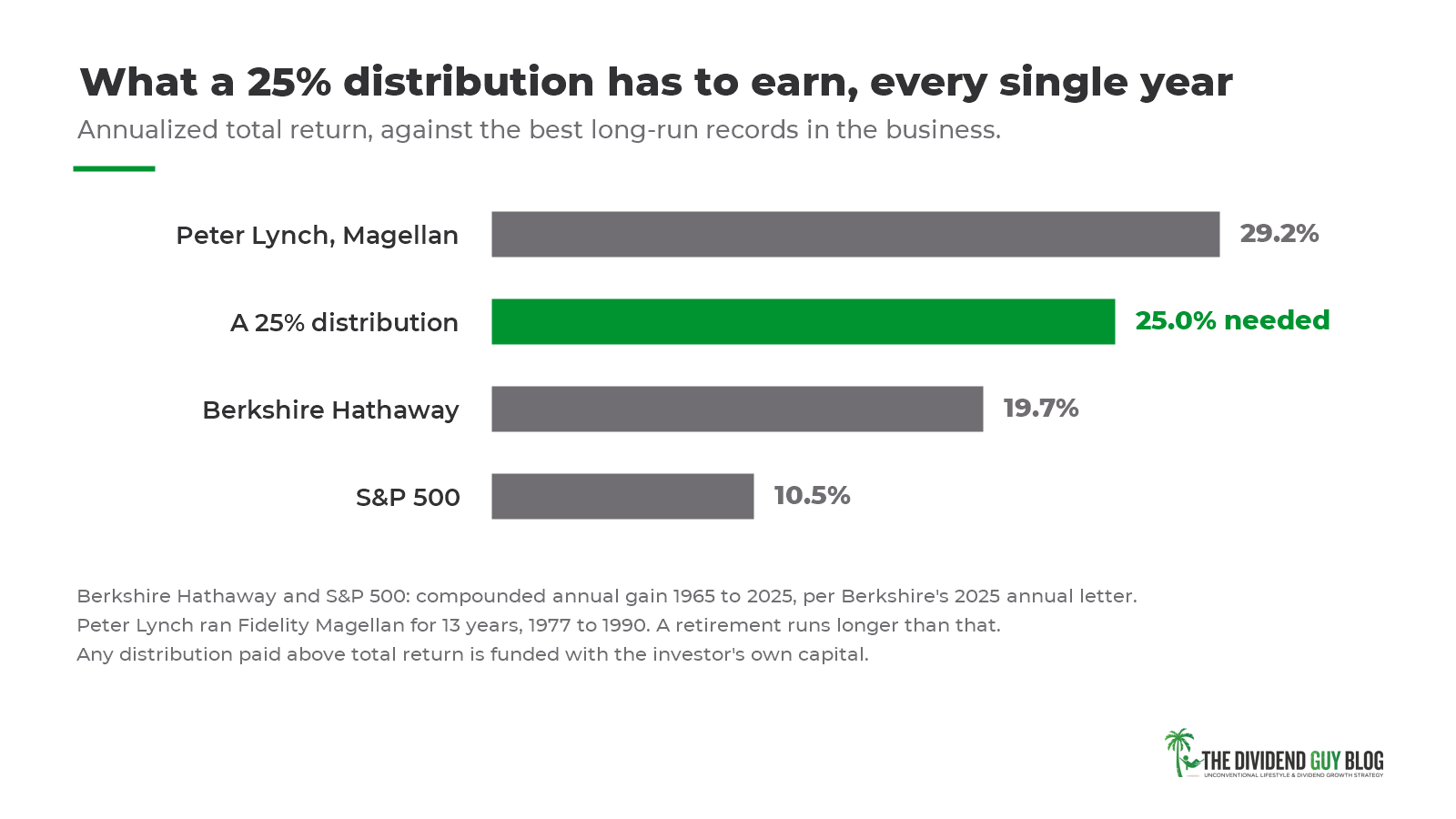
No product has proven it can. Most of them launched into a bull run and have never faced a real drawdown, and a 25% distribution needs a 25% total return behind it.
Start with the track record, because most of these products do not have one. Three years is not a track record. Five years is not one either. A strategy earns your retirement after it goes through a complete market cycle, with a proper drop in the middle, and comes out the other side still paying.
Look at when they arrived. These products flooded the market right before several years of 20% annual returns. Over a stretch like that, a monkey with a dartboard made money. That is not evidence of anything.
Even with that tailwind, plenty of them never raised their distribution. Some cut it.
Now the math, because this is where it breaks. A distribution has to be funded. If the product does not generate 25% in total return, year after year, part of what lands in your account is your own capital coming back to you. Holding a 25% distribution for the next 25 years would mean beating Peter Lynch and Warren Buffett working together, for a quarter of a century. Nobody clears that bar. We do not live in that world.
Before you write to me about the product that has worked for you since 2023, so did everything else.
Paper Income Is Not Income
A reader tells me he earns $187,500 a year on a $755,000 account. Fine. How much of it did he withdraw and spend last year?
If the answer is none, it is not income. It is paper income.
We already accept this idea in the other direction. When a stock doubles and you have not sold, nobody calls that a profit. It is a paper profit. A distribution that never leaves the account deserves the same label.
What About Mature Companies Paying 5% or 6%?
That portfolio worked for decades. It does not work now, because most of the names left yielding 5% and up share one flaw: weak revenue growth and a dividend going nowhere.
This is dividend investing the classic way. Buy blue chips paying 4%, 5%, 6%, collect the checks, sleep well. It worked, and I am not going to pretend it did not.
The market has run so far that the list has thinned out. The high yielders still standing are, for the most part, the businesses that did not participate. There are exceptions. You do not build a retirement plan on a handful of exceptions.
Run the survivors through the dividend triangle and the same picture keeps showing up.
Revenue growth is struggling. The company is not winning new customers and not selling more to the ones it already has. When sales don’t grow, profit is even harder, because inflation keeps pushing expenses up. Flat revenue against rising costs is a margin story with one ending.
So the dividend gets maintained. Maintained until it gets cut, or maintained for a decade while inflation eats what it buys. That is how a retiree goes from filet mignon to Kraft Dinner. I tried serving Kraft Dinner to my kids. They were not impressed. I loved the stuff when I was their age. I prefer the filet now.
Would you fill a retirement portfolio with companies with no growth ahead, thin profits, and a dividend that hasn’t moved in three years? It pays you today, and it bites you later. The point of retiring is that going back to work becomes a choice, not a bill you have to cover.
Why Do Quality Dividend Stocks Yield So Little Now?
Because everybody wants to own them. A business growing its revenue, its profit and its dividend attracts buyers; the price climbs, and the yield falls. The low yield is the receipt.
Investors read that as a warning. I read it as confirmation.
Think about what happens to a thriving company. It grows sales. It grows profit. It raises the dividend every year. Investors notice and they buy it. The stock price goes up and the yield goes down. The yield went down because the business delivered.
Canadian banks are the clearest example I know. They anchored income portfolios in this country for two decades. Most of them now yield under 3%. National Bank and Royal Bank belong in the low-yield, high-dividend-growth category today, and shareholders who held them through that move did fine.
The yield fell. The dividend never did.
Does Yield on Cost Fix the Problem?
It does not. Yield on cost measures a purchase you made years ago. You retire on what the account is worth today, so the yield that counts is the one on today’s value.
This is the objection I get every time. Mike, the portfolio shows 2%, but my yield on cost is 8%.
I know. Mine is too.
I bought Apple in my RRSP back in 2013 or 2014. My average cost is around $13 a share. At that cost, Apple pays me close to 8% today. By that measure, I hold a high-yield stock called Apple.
Then look at the position itself. The $1,400 I put into it back then is worth about $32,000 now.
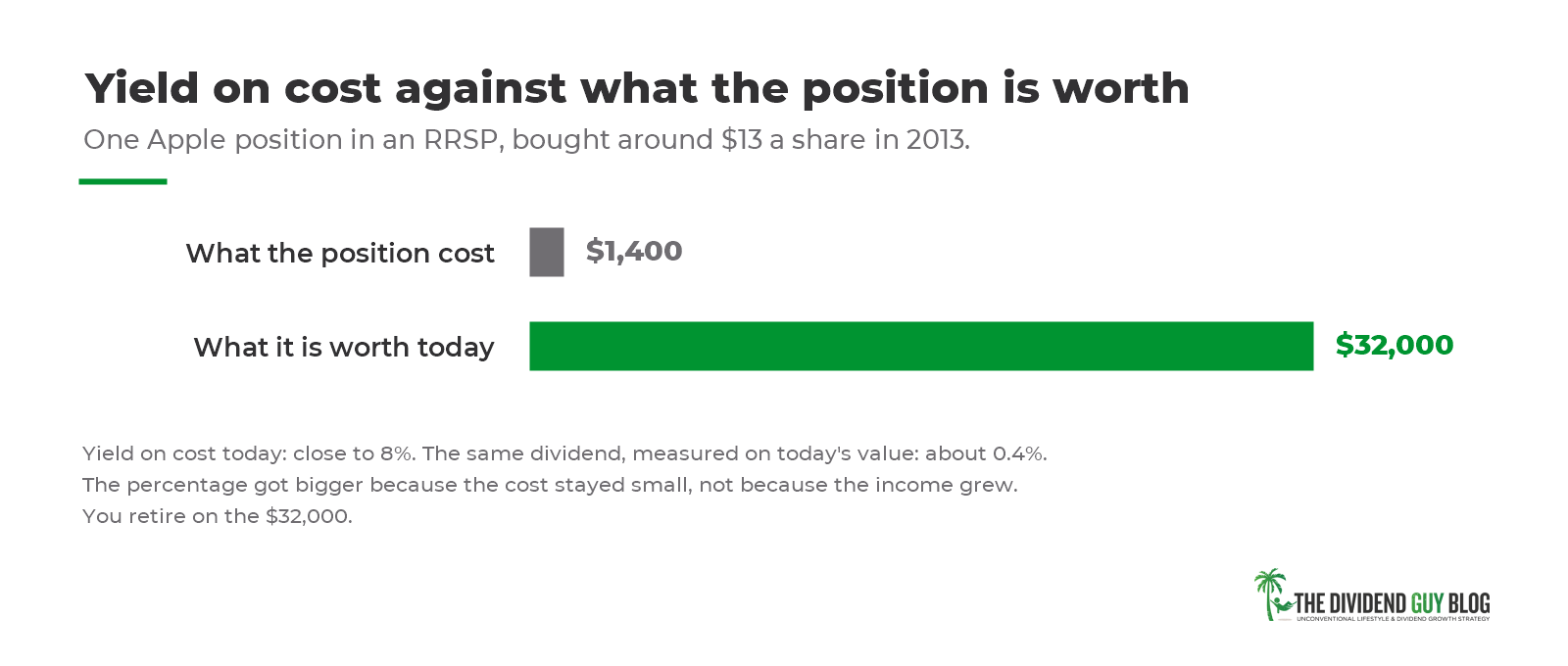
So which would I rather own? The $1,400 throwing off 8% on cost, or the $32,000 it became? I will take the $32,000. If you prefer the $1,400 and the bigger percentage, it is yours.
Yield on cost feels good. It tells you the purchase worked, and that matters. It does not pay for anything.
When you retire with $750,000, you retire with $750,000. Not with the $200,000 you invested fifteen or twenty years ago. The yield that funds your retirement is the one calculated on today’s account value.
What the Dividend Triangle Looks For
Revenue growth, earnings growth and dividend growth over five years, plus cash flow growth and debt under control. The screen works on a 0.7% yielder the same way it works on a 5% one.
A company that clears all of those is thriving. It sells more, keeps more, and shares more with its owners. Whatever yield it pays today tells me about its price, not its quality.
That is why the starting yield never enters the screen. Direction does. A business paying 1.8% and raising the dividend 12% a year is telling me more about the next decade than a business paying 7% with a frozen payment.
The triangle is not perfect. There are exceptions and I have owned a few of them. It still beats buying the biggest number on the screen and hoping the distribution holds.
You can read more about how I put this to work below.
Get the Dividend Income for Life Guide

My Dividend Income for Life guide compares 48 dividend stocks over ten years, high yielders against dividend growers, and shows what each one paid its owner.
Enter your name and email below to get your free copy.







Leave a Reply