
“Dividend investing as I knew it and loved it is dead.”
That is not my line. It belongs to Todd Wenning, a dividend investor who spent years making the case for dividend growth stocks. He published it on Flyover Stocks. The Globe and Mail picked it up. A reader named Kevin sent it to me.
I read it twice. Then I did something you might not expect from a guy who has been following a dividend growth investing strategy since 2010.
I agreed with most of it.
Not all of it. But most of it.
Here is what died, what survived, and how I run a dividend portfolio in a market where the old playbook stopped working.
*Disclosure: I own Apple (AAPL), Microsoft (MSFT), Alphabet (GOOGL), Broadcom (AVGO) and Costco (COST). This is education, not advice. Do your own due diligence.
Is Dividend Investing Dead?
No. What died is the 3% to 4% starting yield paired with 6% to 7% growth. The dividend metrics still work as a screen for business quality, and dividend growers still exist.
That distinction matters, so let me walk through what changed and what did not.
Why the Dividend Playbook Worked in the First Place
Wenning’s original case rested on five ideas. They line up with the rules I teach at Dividend Stocks Rock.
Dividends come from cash flow, not accounting. A company can dress up earnings. It cannot dress up a wire transfer to your brokerage account. When a business raises its payment year after year, cash flow is growing behind it. If not, the board made a foolish decision that will surface within a few quarters.
A rising dividend signals confidence. Management is telling you they expect more cash next year than this year. That is a forecast with money attached to it.
Dividend growth points to a competitive advantage. A company that generates more cash than it needs to defend its position owns something the competition does not.
A dividend proves the board thinks about shareholders. Value gets converted into dollars that land in your account.
A dividend shrinks management’s sandbox. This is the one investors skip. Cash committed to shareholders is cash that cannot fund a bad acquisition. Capital allocation gets sharper when the budget gets smaller. That is the theory. It does not always play out. The incentive is real.
His target back then was a diversified portfolio yielding 3% to 4%, with cash flow per share growing 6% to 7% a year.
A paycheck today, and a raise that beat inflation.
Why That Portfolio No Longer Exists
A 3% to 4% yield paired with 6% to 7% cash flow growth has become rare. There are not enough of those companies left to fill a diversified portfolio.
Try to build it today. You will find a handful of names. Not forty.
Canadian banks used to fit the bill. For two decades they anchored every income portfolio in this country. Most of them now yield under 3%. The math that made them the automatic choice no longer works the same way.
Wenning points to three shifts. He is right on all three.
The Classic Staples Are Under Attack
Coca-Cola. Colgate-Palmolive. J.M. Smucker. Clorox. These were the Dividend Aristocrats you bought and forgot about.
They now compete against private label brands, influencer-driven upstarts and a shopper who reads labels. Add GLP-1 drugs reshaping how people eat, and the volume growth these businesses counted on gets harder to find.
Many of them pay out more than 75% of earnings. That leaves little room to reinvest, adapt or acquire their way out of the problem. Diageo cut its dividend in 2026. Ten years ago, nobody modeled that.
Boards Would Rather Buy Back Stock
Since the SEC cleared the path in 1982, buybacks have taken share from dividends. They are flexible. They are tax efficient in a taxable account. And the average new board member is 59 years old, which means these directors built their careers in the buyback era.
I have no problem with buybacks. A company that repurchases shares at a fair price and retires them creates value. Paired with a growing dividend, it is a strong package.
The problem is reliability. A buyback gets announced, then it speeds up, slows down or skips a quarter. Nobody holds a press conference to explain why. Worse, plenty of boards buy at the top and destroy value on the way down.
A dividend increase is a public promise with a track record attached. That is why I still prefer it.
The Index Got Younger
The average age of an S&P 500 company fell from 57 years to 15. Campbell’s, Newell Brands, Macy’s, Xerox and Harley-Davidson all left the index. Those companies were founded in 1869, 1903, 1858, 1906 and 1903.
The businesses replacing them are younger, faster and hungry for capital. They pay their people in stock, not their owners in dividends.
Where I Part Ways With Todd Wenning
The 3% to 4% yield model is dead. Dividend growth investing is not. Some of the best dividend growers today sit in the sectors blamed for killing the strategy.
Read his article again and you find the counterargument inside it.
He names GLP-1 drugs as a threat to staples. Who sells those drugs? Eli Lilly. A company with a strong dividend triangle and a long record of increases.
Costco appears in the story about the pressure on the old Staples. Costco is one of my holdings. It is one of the better dividend growers I own. Its yield sits well under his 3% floor.
He points to technology absorbing all the capital. Technology is one of the largest sectors in my portfolio. Broadcom. Alphabet. Apple. Microsoft. Small yields. Strong balance sheets. Dividend increases year after year after year.
His diagnosis is accurate. The conclusion drawn from it is too narrow.
What died is a yield target. What survived is the signal.
How I Invest Now: Yield Agnostic
I ignore the yield and read the dividend metrics as clues about business quality. Dividend trend, current yield against the 5-year average, payout ratio, dividend triangle.
I started this in 2010. Sixteen years later I run the same process.
I do not care about the yield. I care about what the dividend tells me.
Here is the checklist.
- The dividend growth trend. Is the payment rising every year? For how long? Did the growth rate slow down? A company that goes from 8% raises to 2% raises is telling you something about its cash flow before the income statement does.
- The current yield against the 5-year average yield. A yield above the historical average can flag a discount. A yield under it can flag a stretched price. That is a valuation clue you get for free.
- The payout ratios. Both the earnings payout and the cash payout. A rising payout ratio with flat cash flow is a warning sign. That is how a dividend cut gets built.
- The dividend triangle. Revenue growth, earnings growth, dividend growth. All three pointing up over five years. This screen works on a 0.6% yielder the same way it works on a 5% yielder.
Notice what is missing from that list. A minimum yield.
That is the change. A company paying 0.8% and raising the dividend 15% a year tells me more about its future than a company paying 6% with a frozen payment for three years.
Companies that pay no dividend at all give me none of these metrics. That is not a rule against owning them. It is the reason my process starts with dividend payers.
How Do You Retire on a Portfolio Yielding 1.5%?
You build your own dividend. Treat the portfolio as a holding company and pay yourself a distribution funded by dividends, interest, fund distributions and capital gains. You set the income, not the boards of the companies you own.
This is the objection I get every week, and a reader named Edward sent me a version of it.
Fair question. The answer starts by dropping an assumption most dividend investors carry without examining it. The assumption is that retirement income must arrive as a dividend payment.
It does not.
Think of your portfolio as a holding company. You are the CEO. Your job is to pay yourself a distribution. That payment can come from dividends, interest, fund distributions and capital gains. You decide the mix.
This puts you in control of two things at once. You control which businesses you own, because you are no longer forced into high-yield names to hit an income number. And you control your income, because you set the amount instead of waiting for a board to set it for you.
The dividend still matters. It funds part of the payment and it confirms the business is healthy. It stops being the only source of your paycheck.
I own technology companies yielding 0.7% next to companies paying 5%. The portfolio pays me what I decide it pays me.
Dividend Income for Life: What and When to Buy in an Overvalued Market?
Reading a framework is one thing. Watching someone run it against a market at an all-time high is another.
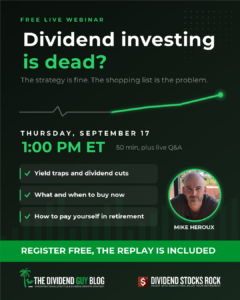
On Thursday, September 17 at 1 PM ET, I am hosting a free webinar: Dividend Income for Life.
I cover why traditional dividend investing is failing investors, how yield traps set up the cuts that follow, and the method that puts quality ahead of yield. Then, how to build a retirement paycheck from your own portfolio, including the withdrawal order and the cash reserve, with a full retirement portfolio example built for income that lasts.
About 50 minutes, then I stay for an open Q&A and answer questions live.
Registration is free, and everyone who signs up gets the replay.







The line about younger companies paying their people in stock rather than their owners in dividends connects directly to the buyback-reliability point, and it suggests an addition to your checklist.
Gross buybacks at many of the tech names you mention largely offset stock-based compensation, so the share count barely falls – the buyback is real cash out the door, but it goes to employees rather than to continuing shareholders. Measuring net shareholder yield (dividends plus buybacks, minus new shares issued) separates the companies genuinely shrinking their share count from the ones running to stand still. It pairs naturally with your cash payout ratio: one tells you whether the distribution is funded, the other whether it actually reaches the owners.