
Every building has to stay warm in winter and cool in summer. That never changes. What is changing is how much heating and cooling this economy demands, and who gets paid when that demand shows up.
Data centers run hot, and the AI buildout is adding cooling load nobody planned for five years ago. At the same time, older homes and offices keep replacing aging furnaces and air conditioners, and that spending does not wait for a good economy. A furnace that dies in January gets replaced in January.
So I followed that chain this month. Two names came back and went onto my buy list. One builds the systems. The other moves the gas that fuels a large share of the heat.
I think there is a play in each of them. Both have pulled back since July while the businesses kept moving forward, which is the setup I go looking for. They are priced nothing alike, and each one asks you to accept a different risk.
*Disclosure: I do not own Trane Technologies (TT) or AltaGas (ALA.TO). This is education, not advice. Do your own due diligence.*
How to Read My Buy Ideas
One rule before we go any further. Do not read a stock name here and then buy it.
I am not joking. When I go write about a company, it can read like every name is an amazing pick. Each one made the list for a reason. I think there is a play here. Will I be right most of the time? Who knows. What I can promise is the work and a big push for your own research. I want you to see how I read a business model, where I find the growth vectors, and where I find the flaws.
The screen does the first job. A PRO rating of 4 or better says the business quality is there. A Dividend Safety score of 4 or better says the payment is not at risk. Then comes the question I answer for myself every single time. Can I live with this type of risk?
We do not all answer that one the same way. I happily live with the risk of overpaying for a stock. Some investors would lose sleep over my portfolio’s average P/E ratio. Trane and AltaGas both carry a 4 on each score, and each one asks for a different kind of tolerance.
You can read about my previous picks below.
2 Stocks on My Buy List: Northrop Grumman and CCL Industries
Trane Technologies (TT): Paying Up for the Cooling Super Cycle
Investment thesis: Trane is a global climate company. Through the Trane and Thermo King brands, it sells commercial and residential heating, cooling and ventilation systems, building controls and transport refrigeration. It reports in three regions: the Americas, Europe with the Middle East and Africa, and Asia Pacific. The Americas segment is the engine. Trane also builds turnkey data center cooling solutions and liquid cooling technology, which puts it in the middle of the AI power story.
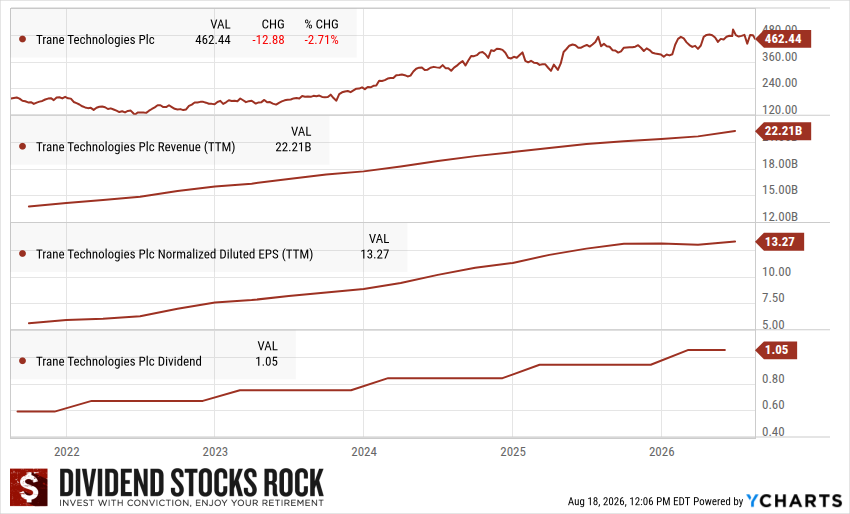
The dividend triangle is strong. Revenue has grown 9.8% a year over five years, earnings per share 18.75%, and the dividend 12.2%. Q2 2026, reported July 30, pushed it further. Revenue rose 11% and adjusted earnings per share 11%, bookings jumped 39% to $7.8B, and the backlog hit a record $12.1B, up 70%. Americas commercial HVAC bookings set an all-time high, up 50%, and applied bookings rose 130%, a fourth straight quarter above 100%. Management raised full-year guidance to roughly 11.5% reported revenue growth with adjusted earnings per share of $15.20 to $15.30.
The moat sits in the installed base. Once a building runs on Trane equipment and controls, the parts, upgrades and service contracts can run for years, and that revenue arrives whether the economy cooperates or not. Switching away means ripping out a system that works. Carrier, Johnson Controls, Daikin and Lennox all compete here, and none of them dislodges an installed base overnight.
Read the dividend as a growth signal, not an income one. The forward yield is 0.85%, below the five-year average of 1.20%, because the share price has climbed faster than the payout. The payout ratio is 28% on earnings and 27% on cash, and the raises have averaged 12.2% a year. You buy Trane for the rising dividend and the earnings compounding behind it.
Now the risk you sign up for. The stock trades near 36.7 times trailing earnings against a five-year average of 30.3; the forward multiple sits near 31. The market already knows this is a great company. That leaves no room for a miss, and any quarter that falls short of the bar could trigger a pullback. The soft spot is Europe, the Middle East and Africa, where revenue fell 1% in the second quarter and adjusted operating margin dropped 420 basis points. If the AI capital cycle cools, the data center tailwind fades faster than the market expects.
So where is the play? Part of it is the price. Trane set an all-time high of $505.87 on June 25 and traded around $479 in mid-August 2026, so you are buying around 5% below the peak instead of into it. The rest is in the backlog. A record $12.1B, up 70%, with bookings up 39% and guidance moving up instead of down, means earnings are chasing the price rather than the other way around. Buying Trane still means paying ahead of that catch-up. That is the overpaying risk, and it is one I can live with. But that choice is yours.
What to watch: backlog and bookings, since that is the stock’s swing factor. Data center cooling orders and any commentary on liquid cooling demand. Americas commercial HVAC volumes and the pace of the European recovery.
AltaGas (ALA.TO): A Rare Moat Carrying a Heavy Load
Investment thesis: AltaGas runs two platforms. The first is a regulated US natural gas utility, principally Washington Gas, serving over 1.6 million customers across DC, Maryland, Virginia, and Michigan. The second is a western Canada midstream business built on extracting, processing and exporting liquefied petroleum gas. AltaGas owns RIPET and Ferndale, the only two large-scale LPG export terminals on the North American West Coast.
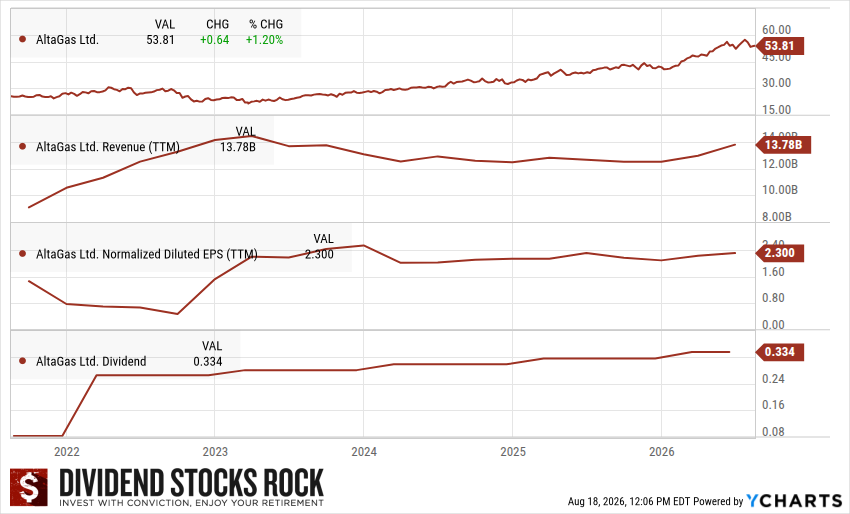
The two platforms split EBITDA roughly evenly across a full year, and they do different jobs. Utilities earn approved returns on rate base investment, which is about as predictable as cash flow gets. Midstream captures the spread between West Coast Canadian supply and Asian demand, a netback Gulf Coast exporters cannot match. Q2 2026, reported July 30, was another record. Normalized EBITDA rose 14% to CA$391M and normalized earnings per share rose 15% to CA$0.31, with Midstream up 33% on record LPG exports of 144,420 barrels a day to Asia. Management raised 2026 guidance to CA$2.0B to CA$2.1B of normalized EBITDA and CA$2.35 to CA$2.60 of normalized earnings per share.
Owning both West Coast terminals is close to irreplaceable. A new one takes years of permitting, heavy capital, and the rail and port relationships AltaGas spent years building. On the utility side, regulated monopoly status across four US jurisdictions produces rate-supported earnings that do not move with the commodity cycle. Pembina, Keyera and Enbridge compete for NGL handling, and none of them owns that export footprint.
The dividend comes with an asterisk, and I would rather say it than skip it. AltaGas cut its payment in 2019 after saying it would not. Management then rebuilt the balance sheet and has delivered six straight annual increases since, including a 6% raise in 2026 that took the dividend to CA$1.336 a year. DSR upgraded the Dividend Safety Score to 4 in March 2026. The forward yield is 2.45% and the payout ratio is a comfortable 51% on earnings. Ignore the five-year dividend growth rate of 31.25%. It is a rebound from the cut, not a forecast. Plan on 5% to 7% a year, in line with EBITDA.
Now the risk you sign up for here. This business borrows to build. Financial debt sits at 6.13 times EBITDA, down from 6.75 but still heavy, and that keeps the shares sensitive to long-term rates, which lift refinancing costs and the discount investors apply to the stock at the same time. Rate recovery has to land across four US jurisdictions at once, midstream cash flow depends on RIPET uptime and rail performance, and management raised the 2026 capital budget from CA$1.7B to CA$1.8B, so the building is not slowing down. Shares are up 41.5% over the past year, though they have given back some of that since late July.
The play here looks nothing like Trane’s, and the price reflects that. AltaGas peaked at CA$57.52 on July 24 and traded around CA$52 in mid-August 2026, roughly 9% off that high, after an equity issue took the wind out of a record quarter. Here is the part worth sitting with. That same equity, plus a bigger EBITDA base, is what brought financial debt to EBITDA down from 6.75 times to 6.13. The move that knocked the stock down is the move that made the balance sheet safer. You are not waiting on earnings to catch up to a multiple. You are being paid 2.45% to hold a regulated utility bolted to the only West Coast LPG export terminals in North America, with a payout ratio at 51% and management raising both guidance and the dividend. Rates are still the swing factor. If they ease, the shares have room. If they spike, the debt becomes the story.
What to watch: RIPET export throughput and the FEI to Mont Belvieu spread, which drive the midstream upside. On-time delivery at REEF, MVP Boost and Southgate. Utility rate case outcomes across the four US jurisdictions. And long-term interest rates, given the debt load.
Can You Live With This Kind of Risk?
Both names are on my list because I see a play in each, and price is part of that play. Let me be clear about the size of it. Neither one is a big bargain. These are small entry points for the investor who wants good quality at a good price, not a fire sale. Both are cheaper than they were four weeks ago while the businesses behind them kept getting better. So the useful question is not which one is the better deal. It is which risk you can hold through a bad year without selling at the bottom.
Trane asks you to accept overpaying. You are buying an excellent business the whole market can see is excellent, and betting the data center and electrification runway is long enough to grow into that multiple. I can live with that one. Plenty of good investors cannot, and that is a legitimate answer, not a failure of nerve.
AltaGas asks you to accept leverage. Financial debt at 6.13 times EBITDA buys a 2.45% yield, mid-single-digit dividend growth, and infrastructure that would take years and a fortune to replicate. The bet is that rates behave while the utility earns its approved return and RIPET keeps shipping.
One risk lives in the multiple. The other lives on the balance sheet. Answer that question honestly before you go near a buy button, because it decides which of these two, if either, belongs in your portfolio.
The Hard Part Is Knowing When to Buy
Finding Trane and AltaGas took one screen and an afternoon. Deciding what to pay for them is the part that trips up most investors. A stock trades at 36.7 times earnings. Is that quality worth paying for, or a trap? A stock has pulled back 9%. Do you wait for more, or do you start?
That is what I teach in Dividend Simplified. It is a short, practical course that walks through my buy process, my sell process, and how to read a quarterly earnings report without a finance degree. Bite-sized videos, PDF guides, and the same checklists I use. The whole thing costs $15.
If you have ever stared at a stock like Trane and frozen, this course was built for you.







Leave a Reply