
I have been fully invested in stocks for 23 years. I tell you to stay invested, and I mean it.
Right now, indicators suggest a bear market is brewing.
Four things bother me at the same time, and that has not happened in a while. Not one of them is making me sell a share.
*Disclosure: I own National Bank (NA.TO), Canadian Natural Resources (CNQ.TO), Apple (AAPL) and Microsoft (MSFT). This is education, not advice. Do your own due diligence.
Is a Bear Market Coming?
Four pressures are building at once: stretched valuations, the AI split, climbing long-term bond yields, and tariffs that are about to be felt.
Two of them are ordinary market noise. The other two are not, and one of them makes the first problem worse.
Sign 1: Valuation Has Stopped Making Sense
Canadian banks trade between 17 and 20 times earnings. They have never been priced there before.
You know I do not like talking about valuation. National Bank was overvalued at $100. Greatly overvalued at $125. Crazy expensive at $150. What do you call it past $200?
Part of that is overvaluation. Part of it is a fair rerating, and that is where it gets interesting.
A bank that does mortgages, commercial loans and deposits should not cost more than 13 times earnings. Add asset management, insurance, wealth management and capital markets, and you have a different business with more growth attached. Paying up for that makes sense.
There are also companies trading at 30 times earnings that are not half as solid as a Canadian bank.
So the price makes sense and it makes me uncomfortable at the same time. Both things are true, and that is what bothers me.
I went deeper into this pricing problem earlier this year.
Sign 2: AI Has Split the Market in Two
The market has gone K-shaped. AI winners get bid higher while quality businesses fall 20% to 50% on disruption fears.
On one side, hype. Everyone wants the same short list of names.
On the other side, companies that lost 20, 30, 40, even 50% of their value over one question: what does AI do to them?
In the US, look at Salesforce, Intuit, Oracle and Roper Technologies. In Canada, Stantec, CGI, OpenText and Constellation Software.
Is it true that engineering firms will not make much money from here? I do not believe that. The market is unsure, and that doubt is driving pricing.
This is also why your portfolio may feel broken. The S&P 500 and the TSX are both up double digits this year. Without AI chips or energy, you are not seeing any of it.
One of my best performers this year is Canadian Natural Resources. On a day like this one, part of me wishes I owned more energy. Most days I do not, and that is fine. It is my strategy and I am keeping it.
Sign 3: Long-Term Bond Yields Keep Climbing
Long-term yields are rising because governments keep running deficits. That raises borrowing costs and lowers what investors will pay for a stock.
This is the sign that matters most, and it is the one investors understand least.
What Is Driving Long-Term Bond Yields Up?
Two rates are worth following. The short-term rate is set by central banks, the Bank of Canada here and the Fed south of the border, through the overnight rate. It drives prime and variable rates.
The long-term rate is the 10-year, the 20-year, and the 30-year. It responds to more than the central bank.
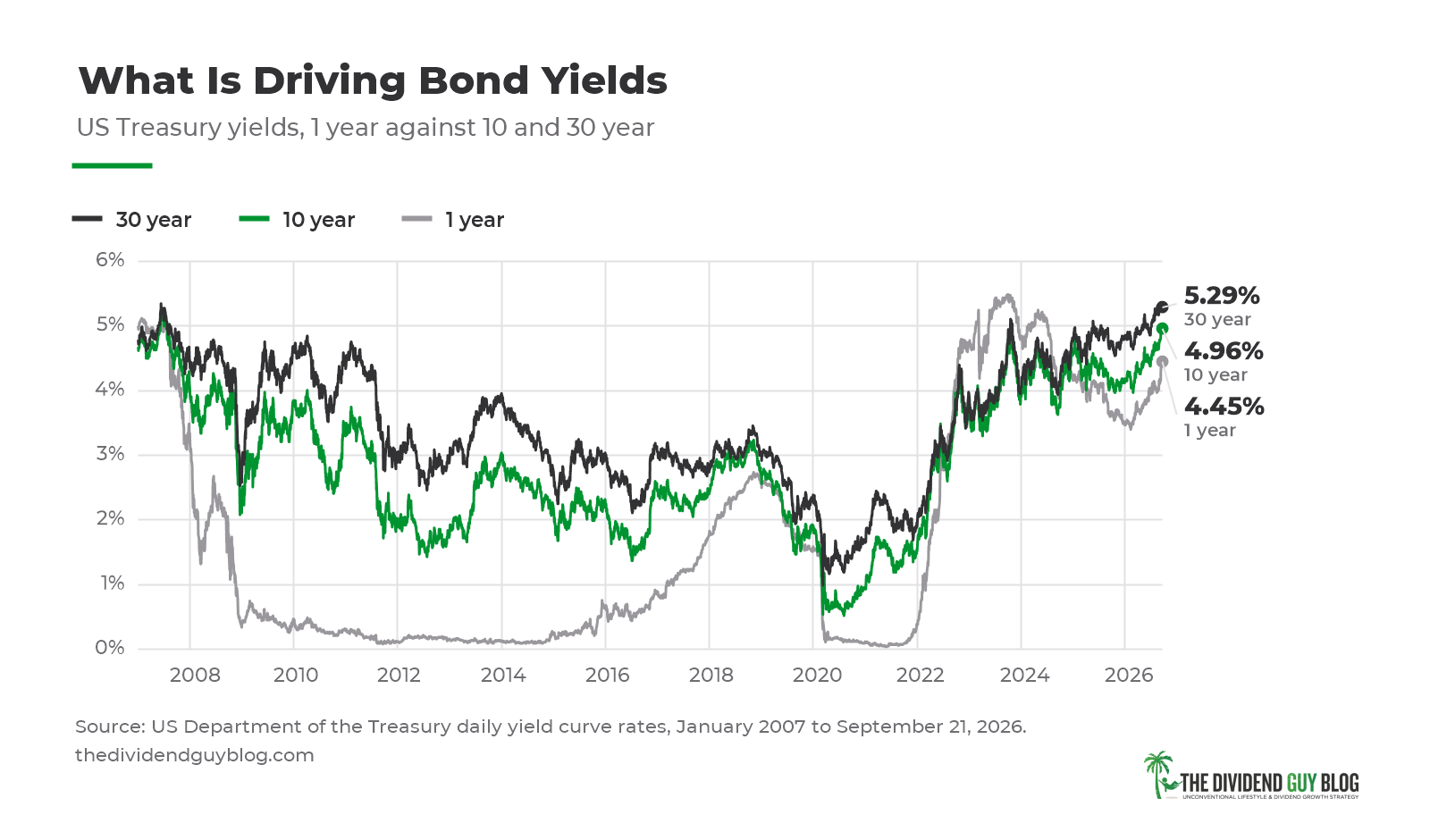
Four things move it. Inflation. The expectation that central banks will raise short-term rates. The level of uncertainty in the market. And government deficits.
Deficits matter most on both sides of the border. Canada and the US are both poor at managing a budget. That is not politics. That is dollars for dollars.
Investors have not lost confidence in governments. They want a bigger payback for lending to them.
The bond market is larger than the stock market. That is where the big money sits, so when it moves, everything else feels it.
Why Higher Yields Push Stock Prices Down
Higher government yields raise mortgage rates and corporate borrowing costs. They also raise what investors demand from everything else they could buy.
An investor who can get more from a bond will not pay 30 times earnings for slow growth. He decides 22 times is his price now. Multiples compress.
That is what hit Rollins, Waste Connections and Dollarama. Good businesses. Investors told them to grow faster before paying those prices again.
Here is the part that confuses people. A company reports revenue growth, earnings growth and a dividend increase, and the stock does not move. That is the bond market talking, not the business.
We saw this in 2022. Microsoft was posting double-digit growth across the board and the stock fell anyway. Apple took a hard hit too. Nothing was wrong with either business. Investors wanted more return and would not pay those prices.
Consumers get squeezed from both directions at once. A mortgage renewal at 1% or 2% more, on top of inflation. Oil keeps climbing, so fuel costs more, transportation costs more, and everything else follows.
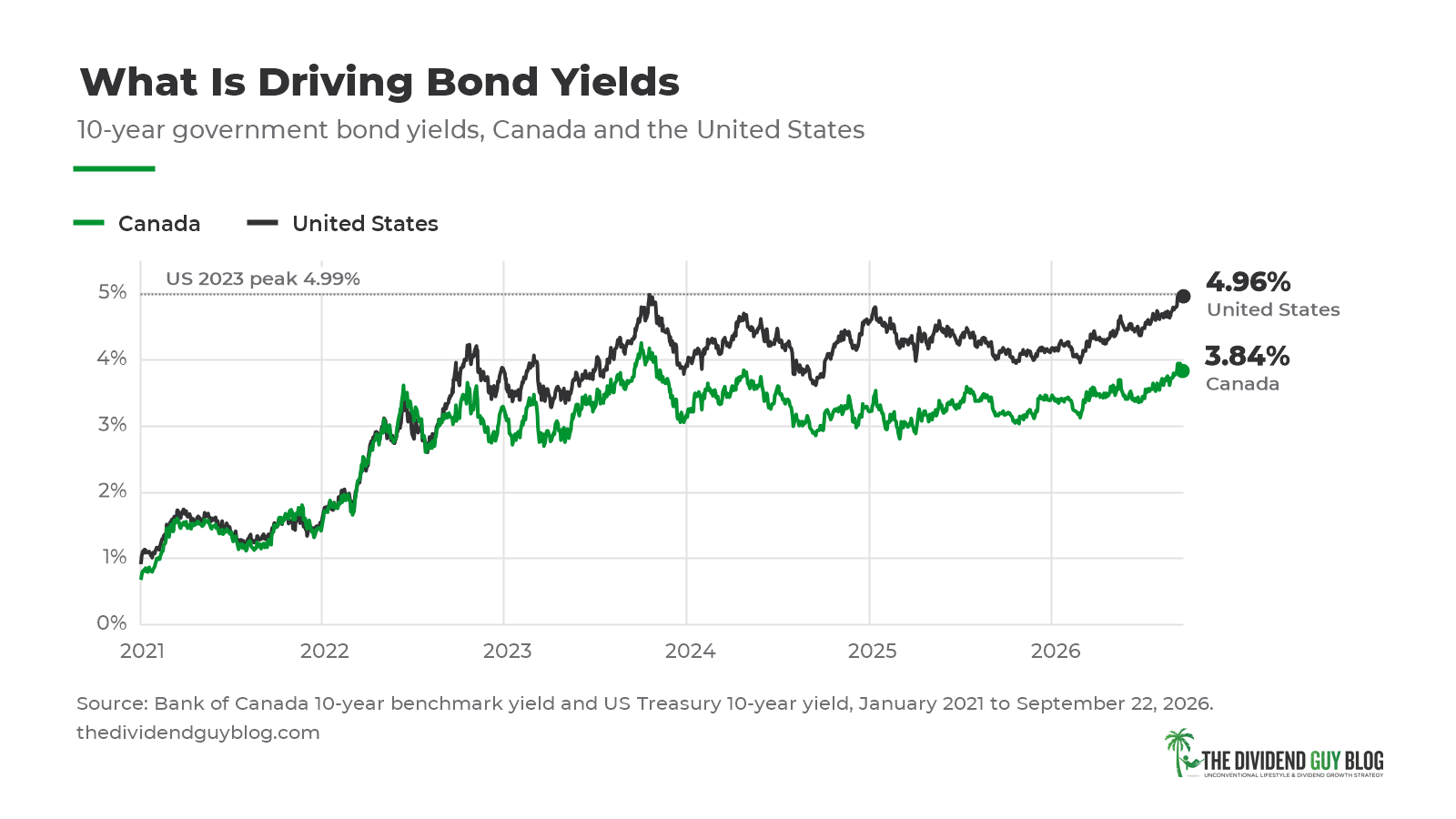
One piece of perspective, and it cuts both ways. The Canadian 10-year is still below its 2023 peak. The US 10-year is not. It set a new five-year high in mid-September, just above where it topped out in October 2023. It is still not the end of the world.
Sign 4: The Trade War Is About to Be Felt
Tariffs were noise for 18 months. The cost now reaches consumer products, cyclicals, defensives, materials and industrials on both sides of the border.
I thought we were done with this one. I avoid the topic because it has been noise, like a neighbour who keeps cranking his speaker for a year and a half.
We are going to feel this one. Consumer products get hurt on both sides of the border. Consumer cyclicals and defensives too. Materials, and probably industrials.
I am not going into politics. I will stay on the investing side.
Why Two of These Signs Pull Together
Stretched valuations and rising yields compound. The market is priced high while investors demand more return, so multiples have one way left to go.
Valuation and AI are ordinary noise. We see both often enough.
Bonds and tariffs are different, and the bond problem connects straight back to the first sign. The market looks expensive. At the same time, higher yields mean investors want more for their money. Two forces, same direction, and the direction is lower multiples.
That is worth understanding. Not so you can time it. So you are not surprised when a company you own reports a good quarter and the stock does nothing with it.
What Protects a Portfolio Through This?
A diversified portfolio of quality businesses. Companies you understand, that keep growing, and that will still be here in ten years.
Diversification and quality. That is the whole shield.
Quality means a business you understand, one that is not going anywhere, and one that keeps growing even while the share price sits still.
A few corners of the market do well out of rising yields. Life insurers hold large bond portfolios. Higher yields mean short-term pain, because the bonds they already hold lose value, and long-term gains, because the money rolls into better-yielding bonds.
If inflation sticks around, gold will likely play its store-of-value role again. It is odd to watch it fall right now.
Energy is the ironic one. Conflict in Iran has tightened oil supply, oil prices are rising, and that feeds inflation. One of the better protections against inflation is materials and natural resources, including oil and gas. That circle can feed itself.
Am I Making Any Moves?
No. I am 100% invested and 100% in stocks, and I sleep well at night.
This period asks for patience. The narrative is loud right now, so I am reading business models and numbers instead.
These things come and go. A problem in the bond market does not mean five years of suffering.
Volatility also lands differently depending on how close you are to retirement.
I am not making any moves. Whether you make any is your call.
Get the Dividend Income for Life Guide
My Dividend Income for Life guide compares 48 dividend stocks over ten years, high yielders against dividend growers, and shows what each one paid its owner.
Enter your name and email below to get your free copy.







Leave a Reply