
Most pipelines lost 10% or more from their summer highs. Williams fell 12%. ONEOK fell 9%. Nothing broke inside either company. Both raised their guidance for the year.
When a whole sector drops for reasons unrelated to the businesses, I want to know which names deserve a closer look. I covered Enbridge and TC Energy in my free pipelines report. Today I am looking south of the border at two companies a Canadian can hold the same way they hold Enbridge.
*Disclosure: I don’t own Williams (WMB) or ONEOK (OKE). This is education, not advice. Do your own due diligence.*
Why Williams and ONEOK?
Williams and ONEOK are ordinary corporations. That matters more than it sounds. They pay dividends, not partnership distributions. The Canada-U.S. tax treaty caps the withholding tax at 15%, and it is waived inside an RRSP.
The highest yields in U.S. midstream come from master limited partnerships. Canadians keep the least of those. Williams and ONEOK are in the other group, the one a Canadian investor can own the same way they own Enbridge.
Both companies move natural gas and natural gas liquids. Both generate strong cash flow. They take very different roads to dividend growth.
Williams (WMB): One Pipe Carries the Thesis
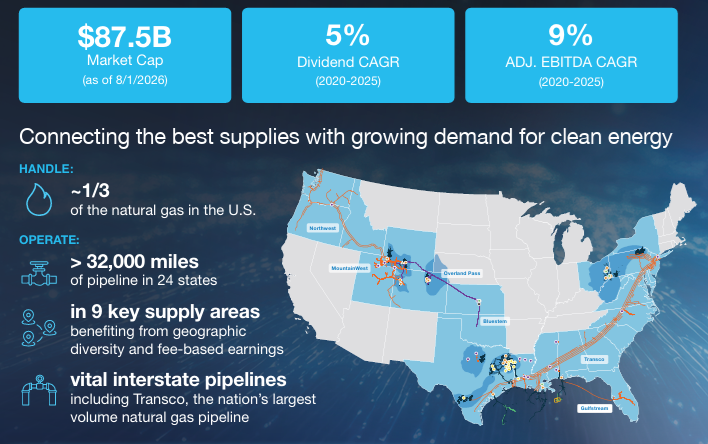
Williams owns Transco, the largest interstate natural gas pipeline in the U.S. It runs from South Texas to New York City and now flows both ways. It links the cheapest gas in North America to the fastest-growing demand on the East Coast. Nobody can build a second one beside it. Morningstar rates Transco as a wide-moat asset inside a narrow-moat company.
The newer piece is power. Williams built a 200-megawatt gas plant for a data center in Ohio in under 18 months. It now has six of these deals, worth US$9.6 billion, on 10 to 12.5-year contracts. In August 2026, it closed the Momentum Midstream acquisition, which connects more Haynesville gas to Gulf Coast LNG plants.
The Williams Dividend Triangle
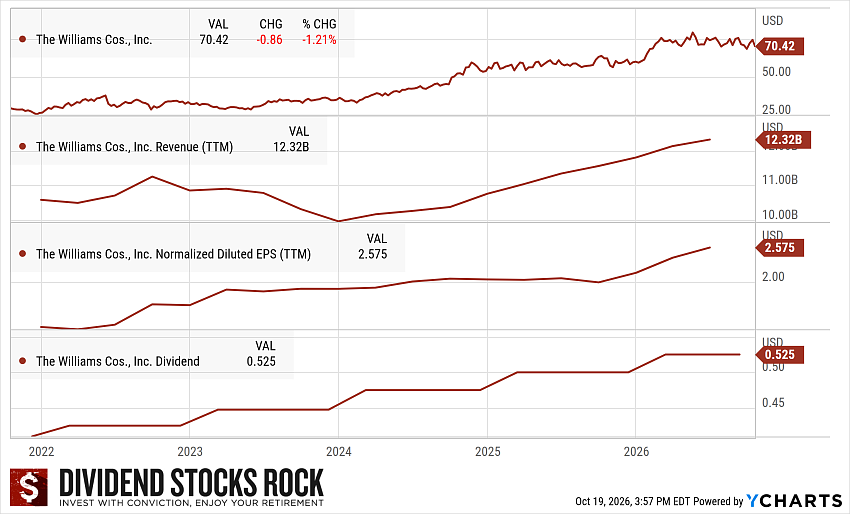
Management targets EBITDA growth of 11% or more over the long term. The dividend grew about 5% a year over the past five years, and 2026 brought another 5% increase. In 2025, cash flow covered the dividend 2.4 times. That leaves room to keep raising it while funding growth.
The yield sits at 3.0%, below its five-year average of 4.7%. A yield above its five-year average can flag a buying opportunity. Here it is the opposite. Even after the drop, the market prices Williams above its own history. It already pays for the growth story.
What Could Go Wrong at Williams?
Gathering and processing is a large part of Williams, and that business moves with drilling. The Momentum deal pushes debt above the 4 times EBITDA ceiling management prefers, for now. Haynesville wells need firm gas prices to keep drilling. In September 2026, a court reversed a water permit for the Northeast Supply Enhancement project.
Williams is also a pure natural gas company. If the power and LNG demand wave stalls, there is no other business to lean on.
ONEOK (OKE): Built by Acquisitions
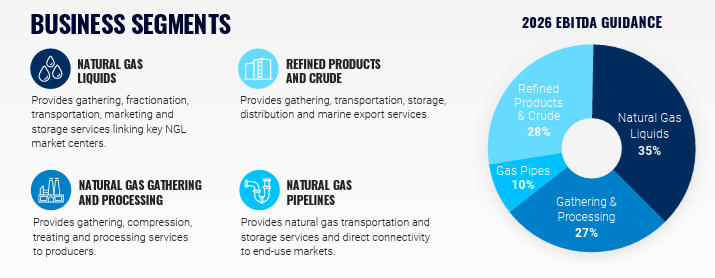
ONEOK started as a natural gas liquids specialist. It then spent about US$34 billion in three years buying Magellan, EnLink and Medallion. That added refined products pipelines, crude oil and Permian gas. More than 85% of earnings come from fee-based contracts.
In August 2026, ONEOK sold a $9 billion stake in its operating company to Apollo. It used $4.45 billion to buy Brazos Midstream in the Permian and $5 billion to pay down debt. Leverage is heading toward 3.25 times EBITDA. ONEOK carries a DSR PRO rating of 4, one notch above Williams.
The ONEOK Dividend Triangle
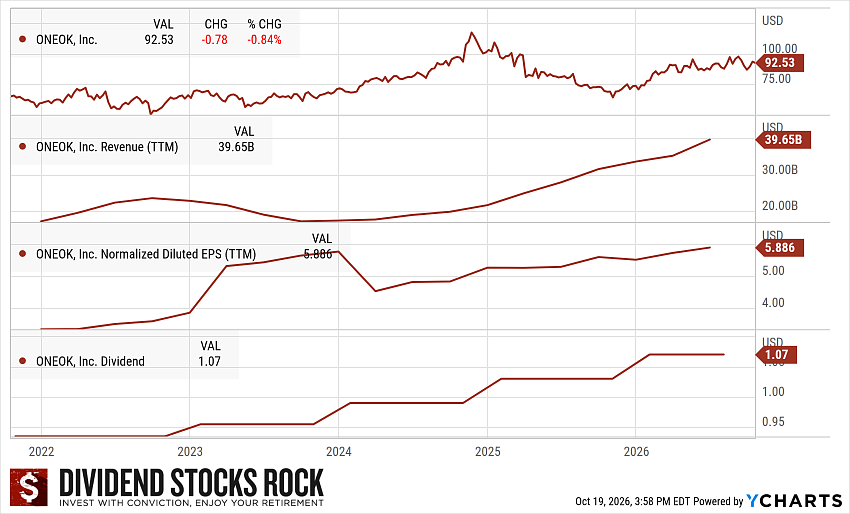
ONEOK yields 4.7%, against a five-year average of 5.7%. The dividend grew about 2% a year over the past five years, and the current streak of increases is three years.
The cash flow picture is tighter than at Williams. In 2025, free cash flow after growth spending fell short of the dividend. The acquisitions should lift cash flow, but they have to deliver first.
What Could Go Wrong at ONEOK?
The Apollo money is not free. It behaves like preferred equity with a 7% hurdle and takes 15% of operating cash flow. That caps what is left for shareholders until it is redeemed, and the earliest date is 2034.
ONEOK also has three large acquisitions to absorb at once. Its marketing pieces swing with commodity spreads. Its Sun Belt Connector pipeline to Phoenix may be canceled because a competing line was sanctioned first. Higher rates also hurt a company that refinances debt every year.
The Verdict
#1 Williams. For dividend growth, Williams wins. It is the closest thing to TC Energy south of the border, with a lower yield and a better growth story. Cash flow covers the dividend more than twice, and the growth comes from a pipe nobody can copy, plus power contracts.
#2 ONEOK. For income in a registered account, ONEOK has the highest yield and the best DSR rating, now that Apollo’s money has reduced leverage. The tradeoff is the slice of cash flow that goes to Apollo before shareholders, and a dividend that has grown slowly.
One more thing from the report. Owning four pipelines does not diversify you. They share the same debt and the same sensitivity to interest rates. You don’t want to put different salts in your soup.
Get the Free Pipelines Report
Williams and ONEOK are two of the names I studied for my North American Pipelines report. The free version gives you the homework I would do before putting any cash to work in this sector.
It explains why pipelines trade like bonds, why GAAP earnings lie here and which cash flow numbers to read instead, and which debt levels call for a closer look. You also get a map of who owns which corridor, scorecards for the Canadian and U.S. names, and full profiles of Enbridge and TC Energy.







Leave a Reply