
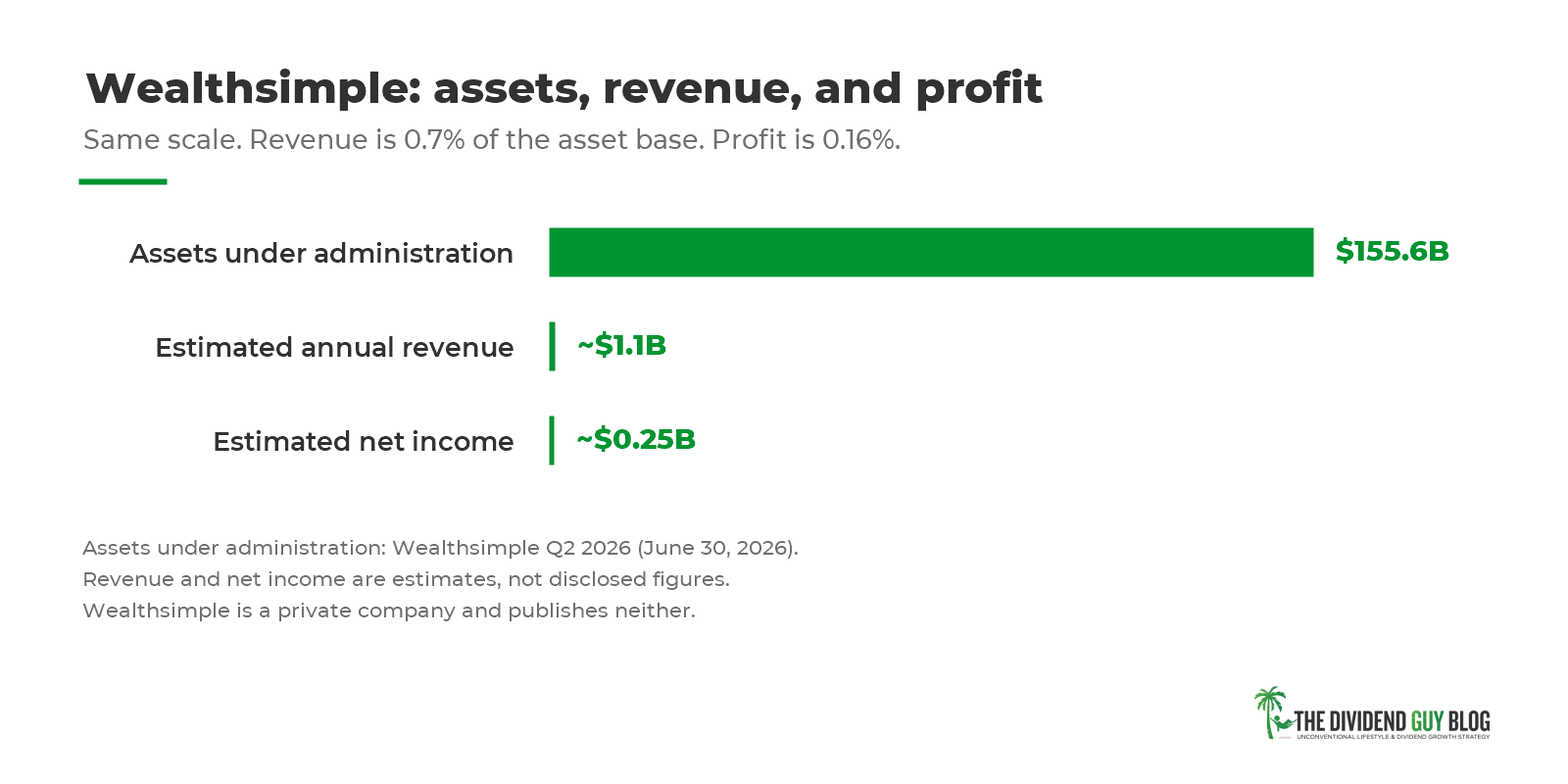
Wealthsimple holds $155.6 billion for 3.6 million clients. Assets are up 84% in one year. The second quarter alone added $30.8 billion, with roughly $17 billion of that arriving as net inflows.
Now open Power Corporation’s second quarter and look for the Wealthsimple line.
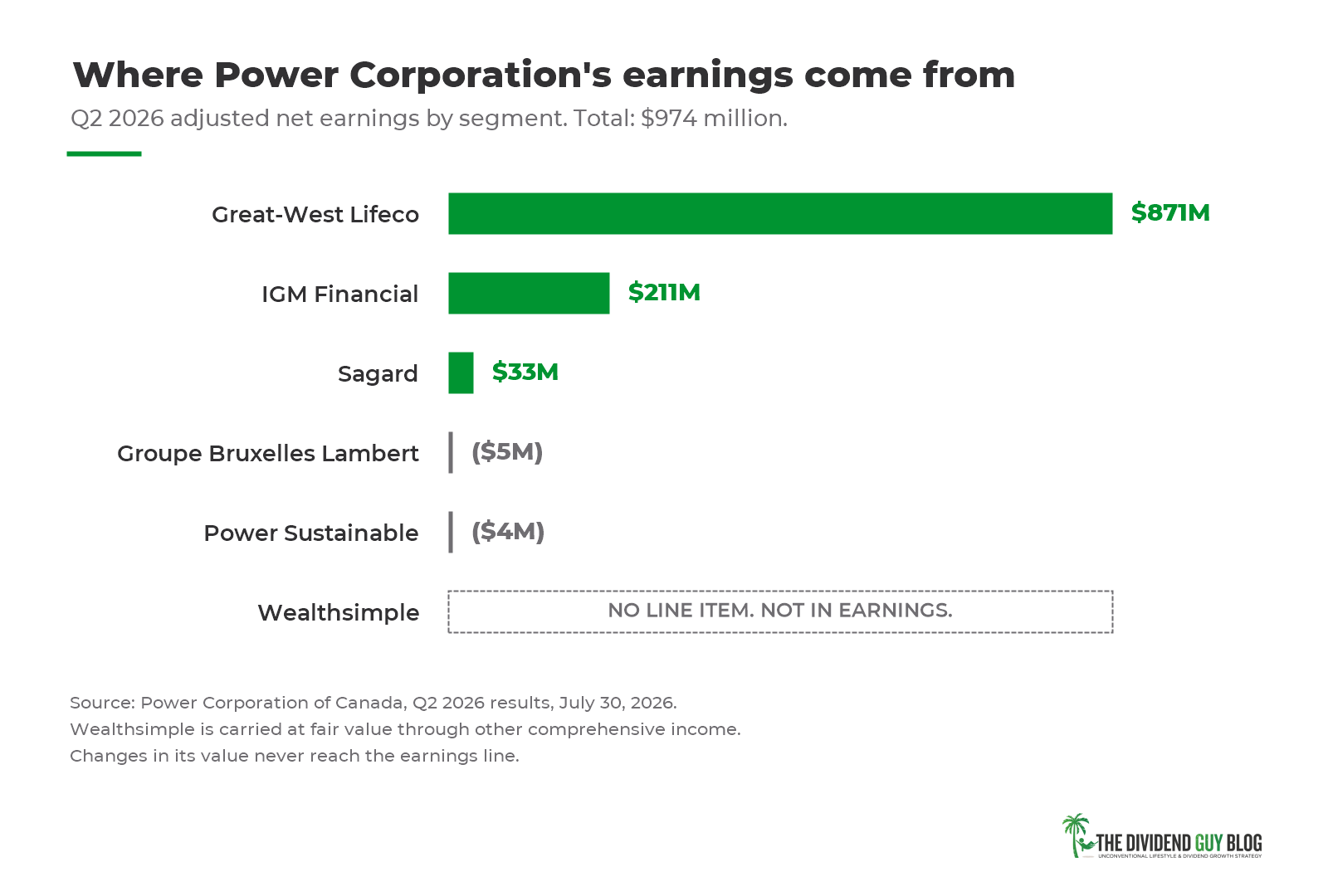
You will find Great-West Lifeco at $871 million. You will find IGM Financial at $211 million. You will find Sagard at $33 million. You will not find Wealthsimple.
That gap between the story and the statement is the whole article.
Here is the short version. Wealthsimple is a real success and the growth is not in question. It is also a business whose profits never reach Power Corporation’s income statement, for a reason most shareholders have never been told.
I am a client, by the way. They dangled a transfer bonus in front of me and I took it, same as a lot of you did.
*Disclosure: I am a Wealthsimple client. I own National Bank (NA.TO) and Royal Bank (RY.TO). I do not own Power Corporation (POW.TO) or IGM Financial (IGM.TO). This is education, not advice. Do your own due diligence.*
Here is the full breakdown on video if you would rather watch it than read it.
How Big Is Wealthsimple Compared to the Banks?
$155.6 billion in assets under administration puts Wealthsimple in the top three or four brokerages in Canada. Questrade holds about $50 billion. TD and RBC sit somewhere near $200 billion to $250 billion.
Those numbers took work to assemble. Wealthsimple is private, so it discloses what it wants to disclose. The banks are public and disclose plenty, but not this. They report wealth. They report investments. Not one of them breaks out what sits inside RBC Direct Investing, Investor’s Edge, BMO InvestorLine or National Bank Direct Brokerage on its own.
I searched. I read financial statements. I used AI to help me dig. The cleanest comparison I found was Questrade, which is not a bank but is a direct competitor, and it has declared roughly $50 billion.
So Wealthsimple is three times the size of Questrade. TD is likely the largest platform in the country with Royal Bank close behind, and my estimate puts each of them in the $200 billion to $250 billion range.
Let me be clear about something before I take this apart. The success is real. Close to one in four Canadians between 18 and 40 uses at least one Wealthsimple product. J.D. Power has ranked it the top brokerage in the country for customer satisfaction three years running. The product is good and I use it.
Top three or four in Canada, from a standing start in 2014. I am not going to pretend that is not impressive.
Then you ask the second question, and everything changes.
What Is the Difference Between Assets Under Administration and Assets Under Management?
Assets under management means the firm charges a fee to manage the money. Assets under administration means the firm holds the money for you. Same dollars on the page, different revenue behind them.
This distinction gets skipped in almost every headline written about Wealthsimple, and it does more damage than any other error in this story.
A dollar under management pays the firm every year, whether the client does anything or not. Think of the 1% management fee your advisor charges. That is a subscription with your name on it.
A dollar under administration pays the firm when the client does something. A trade, a currency conversion, a margin loan, a subscription. If the client buys three ETFs and goes quiet for a decade, that dollar generates close to nothing.
Wealthsimple’s $155.6 billion is mostly the second kind.
Hold that thought while we look at where the money comes from.
How Does Wealthsimple Make Money?
Four sources. Management fees on the managed portfolios, paid subscriptions, foreign exchange fees on currency conversion, and net interest margin on cash balances and margin lending.
Let me take them one at a time.
Management fees. Wealthsimple runs a robo advisor, and that piece behaves like traditional asset management. Recurring, predictable, tied to the asset base. This is the good stuff, and it is a slice of the total, not the whole thing.
Subscriptions. Tiered plans that unlock features and better rates. Small per client, meaningful across 3.6 million of them.
Foreign exchange. Every time a Canadian buys a US stock, dollars get converted. That conversion carries a fee.
Net interest margin. The spread between what Wealthsimple pays you on your cash and what it earns on that cash, plus the interest charged on margin loans.
Look at that list and ask which of those four you feed.
If you hold Canadian dividend stocks in a Wealthsimple account, do not trade often, do not use margin, do not carry a big cash balance and do not convert currency, you are a client who costs money to serve and pays close to nothing. Trading is free. The account is free.
I know this pattern well. I worked in a bank for more than ten years and I had clients exactly like that. Big portfolios, quiet accounts, no options, no margin, no active trading. Lovely people. Terrible revenue.
Now multiply that across millions of accounts.
The one thing worth flagging is that this is changing. Wealthsimple’s own second quarter release credits chequing and spending products for the flows. Chequing balances and credit cards feed net interest margin and interchange, which are better revenue lines than a buy and hold brokerage account. The mix is improving. It is still not a 1% management fee.
What Does Wealthsimple Earn on $155 Billion?
My estimate is $1 billion to $1.2 billion of annual revenue and $100 million to $250 million of net income. Wealthsimple is private and publishes neither figure, so treat this as arithmetic, not disclosure.
Start with the one number we have. Back in 2024, with an asset base near $50 billion, Wealthsimple was running about $129 million of revenue in a quarter. Annualize it and you get close to $500 million a year at that size.
The asset base is now about three times larger. Apply the same ratio and you land near $300 million to $400 million per quarter, or $1 billion to $1.2 billion for a full year.
Now the margin. Wealthsimple turned profitable about two years ago, so this is a business still early in its margin story. At a 10% to 20% net margin, $1 billion of revenue produces $100 million to $250 million of net income.
Take the top of that range. Call it $250 million. It flatters them, and the point still holds.
Why Doesn’t Wealthsimple Show Up in Power Corporation’s Earnings?
Because of how the stake is accounted for. IGM carries Wealthsimple at fair value through other comprehensive income, and the change in fair value is not recorded in earnings. The gains land in book value, not on the income statement.
This is the part I did not expect to find, and it is a better answer than the one I went looking for.
I assumed Wealthsimple was too small to break out. The real reason is an accounting choice.
IGM Financial owns about 25% of Wealthsimple and carries the position at fair value through other comprehensive income. In plain English, IGM revalues the stake every quarter and the change goes straight to equity. It never touches the earnings line.
At June 30, 2026, IGM marked its stake at $2.6 billion, up 15% in a single quarter. The full Power group interest, held across Power Corporation, IGM and Portage, was valued at $4.4 billion net of carried interest, up 15% on the same basis.
Now look at how Power Corporation reported the quarter. Adjusted net earnings of $974 million. Great-West Lifeco contributed $871 million. IGM Financial contributed $211 million. Sagard contributed $33 million. Groupe Bruxelles Lambert lost $5 million and Power Sustainable lost $4 million.
Add the pieces and you have the quarter. There is no Wealthsimple line because there is nothing to put on one.
Great-West Lifeco alone accounted for close to 90% of Power Corporation’s adjusted net earnings. Insurance. The least exciting business in the group.
That is the sentence I want you to carry out of this article.
So What Are You Actually Buying?
A valuation mark, not a stream of earnings. Wealthsimple’s growth raises Power Corporation’s book value. It contributes nothing to the profits that fund the dividend.
Everything we estimated about Wealthsimple’s profit still matters, and not the way you would expect. That profit never reaches Power’s income statement. What reaches Power is a valuation, and that valuation gets set by revenue expectations and by what public peers trade at.
When IGM raised its mark 15% in a single quarter, it pointed at Wealthsimple’s performance and at revised revenue expectations as the reason. That is a judgment about the future, refreshed every ninety days.
So your exposure to Wealthsimple through Power Corporation is a mark. Marks move in both directions.
Dividends get paid out of earnings.
How Does That Compare to a Bank?
National Bank, the smallest of the Big 6, earned about $4 billion last year. Royal Bank earned about $20 billion. Wealthsimple, on my most generous estimate, earns a quarter of a billion.
My own guess sits at the lower end. They have been profitable for two years, and early profitability is thin. I would put the number closer to $150 million.
Here is the comparison that explains the whole gap. A client with $1 million invested in a fund charging 1% generates $10,000 of revenue a year. Every year. Without anyone lifting a finger.
To generate that same $10,000 from self-directed brokerage accounts, you might need $10 million to $50 million of assets from investors who buy, hold, and pay no trading fees.
Same dollars on a statement. Two different businesses.
What Is Wealthsimple Worth?
About $10 billion, based on IGM’s own mark. A 25% stake carried at $2.6 billion puts the whole company near $10 billion, and the Power group’s combined interest sits at $4.4 billion.
That is a serious number for a company that opened its doors in 2014.
It is also a number any of the Big 6 could absorb without straining a balance sheet. Royal Bank earns twice that in a single year.
I do not expect a sale. Power Corporation is not a distressed seller and the mark keeps going up. But the idea that Wealthsimple is untouchable, or that it is about to eat the banks’ lunch, does not survive contact with the numbers.
What Should You Take From This?
Separate the story from the statement. A great narrative and a meaningful profit contribution are two different things, and only one of them shows up in what you own.
Wealthsimple is good at what it does. The growth is real. The client count is real. If you use the platform and like it, keep using it. I do.
But if you hold Power Corporation because you think you are buying a piece of the Wealthsimple story, look at what you are buying. A $4.4 billion mark, and none of the $974 million of earnings the company reported last quarter. The businesses paying your dividend are insurance and traditional wealth management.
This is the habit I want you to build. When you hear a number that sounds huge, ask what it earns, and then ask where that number lands in the financial statements.
Assets are not revenue. Revenue is not profit. Profit for the company is not profit for your slice of it. And a mark on a balance sheet is not a dividend.
Four questions. They take ten minutes. They protect you from most of what passes for analysis on the internet.
Learn to Read the Numbers Yourself
Everything in this article came from public documents and a calculator. A quarterly press release, one line in IGM’s disclosure about how the stake is carried, a few segment figure s, and some arithmetic. No insider access. No expensive terminal.
That skill is what separates an investor who reacts to headlines from one who checks them. The line that explains this entire article, the one about fair value through other comprehensive income, sits in a place almost nobody reads.
It is also what the third course in Dividend Simplified teaches. Simplified Quarterly Earnings walks you through a quarterly report the way I walk through one. Which lines matter, which ones are noise, how to tell growth that came from the business apart from growth that came from an accounting choice, and how to decide in fifteen minutes whether your thesis is still intact.
The other two courses cover the Simplified Buy Process and the Simplified Sell Process. Three courses, $150 of value, fifteen dollars for the set.







Leave a Reply