
The market is up. Your portfolio is not. A few bad picks, a couple of losers you cannot shake, and the nagging sense that everyone else is at a party you missed. So you start wondering whether it is time to blow it up and start over.
Before you scrap half your holdings and chase a fresh list of winners, let me offer a different read. When someone tells me their portfolio needs a makeover, I do not hear a bad investor. I hear a missing strategy.
The last six months are close to irrelevant. You are investing for the next 30 to 50 years. The real question is not how to find hotter stocks. It is whether you are running a process you can trust through every kind of market.
*Disclosure: This is education, not advice. Do your own due diligence.
Should You Do a Portfolio Makeover After a Bad Year?
Usually not. A weak six- or twelve-month period is noise, not a verdict. The fix is a disciplined review of what you own, not a teardown of the whole portfolio.
A makeover driven by recent performance just swaps one set of bets for whatever is hot today. Do that on repeat and you sell low, buy high, and call it strategy. Sometimes a cleanup is warranted, because we all make mistakes. But a cleanup is a scalpel, not a wrecking ball.
The urge usually shows up in a bull market, when new funds and shiny products are printing big numbers. They look unbeatable right up until they meet their first recession. Give your own plan the same patience you are tempted to hand the latest winner.
Why Comparing Your Returns to Others Is a Trap
Short-term outperformance is easy, and often it is luck. The investor bragging about a 30% year rarely shows you the ten-year record beside it.
I hear it all the time. My strategy is up 30%, yours is not, so mine is better. My first question is simple. Since when? The answer is usually six months ago, maybe a year. Ask about the last ten or twenty years and you get crickets.
I have been that person. Right before the worst trade of my life, I was up 71% in under a year. Everything I touched turned to gold. It was not genius. It was a lineup of lucky factors stacked into a short window. Looking brilliant for a stretch proves nothing about the next thirty years.
Are You Behind, or Just Behind Someone Else?
You invest to reach a personal goal, and for most of us that goal is retirement. The only benchmark that matters is your own plan, not the market and not your neighbour.
So look at the plan. Are you on track? You might be ahead even if, in a year, you feel behind. Last year my portfolio rose maybe 5% or 6%, while plenty of people posted 15, 20, even 25 on the AI and gold run. Good for them. I did not lose a dollar because they were ahead of their own plan. Over ten, fifteen, and twenty years, the process has done its job.
Hindsight makes every winner look obvious. Of course you should have owned gold. It was on its way to $6,000 an ounce, then it settled near $4,000, and six months from now it will be another story. Short-term comparisons do not sharpen your decisions. They just manufacture doubt.
Build a Team, Not a Basket of Winners
Your portfolio is not a pile of hot stocks. It is a championship team you build one player at a time, and every team needs different roles filled.
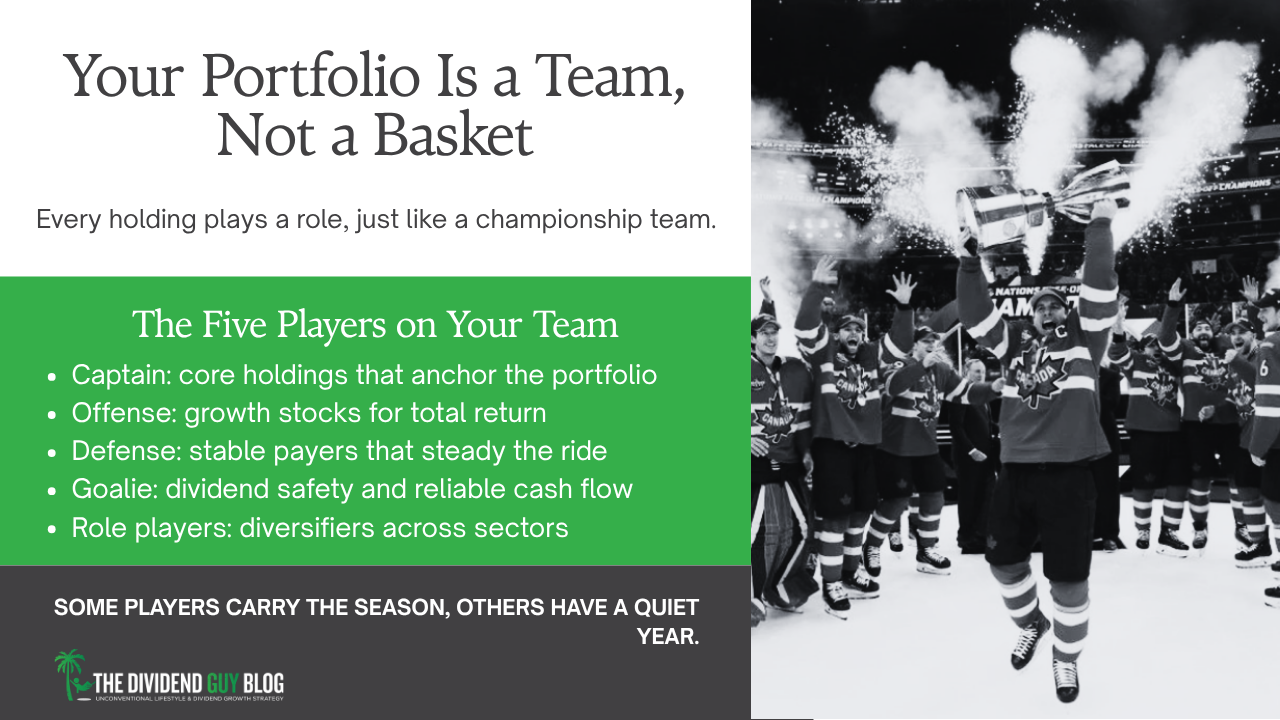
You need offensive players for growth, defensive players for stability, a captain or two to anchor the whole thing, and role players who quietly do their job. Some will carry the season. Others will have a quiet year. That is the design, not a flaw.
Couche-Tard lagged my portfolio for two years. It stung last year. This year it is contributing again. A team built on conviction lets a good player work through a cold streak instead of benching everyone the moment the scoreboard turns.
How to Review a Portfolio the Right Way
Here is the part most investors skip. A real review never starts with the stock price. “Up equals good and down equals bad” is a lazy screen that hands your judgment over to the market. I run the review in three layers, in this order.
Start with your strategy
Before touching a single holding, get clear on how you want to invest. How many stocks do you want to own? Which sectors fit you, and which do you avoid? What kind of business helps you sleep at night? The strategy comes first because every later decision hangs on it.
Check your allocations
Then work through allocation on three levels. Asset allocation first. I want to be fully invested at all times rather than sitting on cash waiting for a perfect entry that never arrives. Sector allocation next, with firm limits so no single sector can sink the ship. Position sizing last. Every holding has to matter. A 2% position that doubles adds less than half a percent to your portfolio, so if a name cannot move the needle, it does not earn a spot.
Review each stock on thesis and numbers
Now, and only now, look at the individual holdings, still ignoring the price. Two things carry the weight.
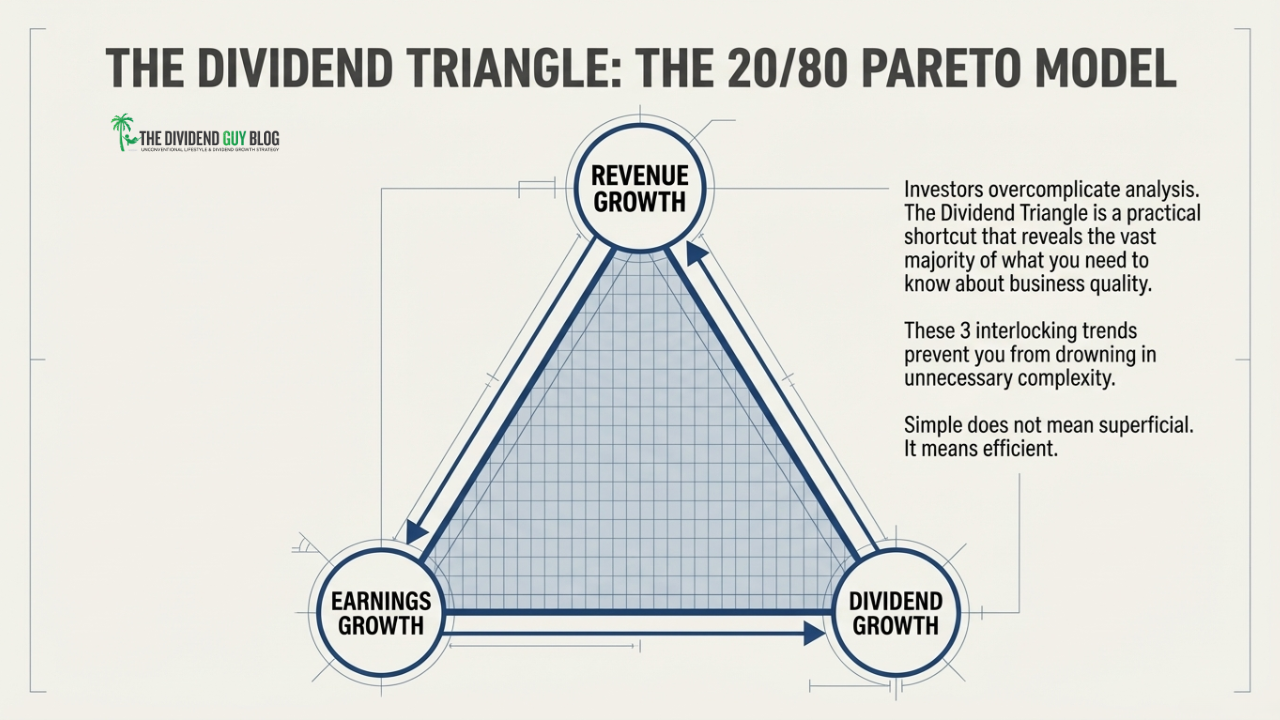
First, the investment thesis. Write down why you own the company. If you cannot explain it to a 12-year-old in two sentences, you have not done the work yet. Second, the numbers, and by numbers I never mean the share price. I mean the dividend triangle. Is revenue growing over five years, and do you know why? Are earnings keeping pace, which tells you margins are holding, or falling behind? Where is the dividend headed, accelerating, slowing, or frozen? When the thesis and the triangle both hold, I do not care whether the stock is up or down this year.
When Does a Cleanup Actually Make Sense?
Sell when the thesis breaks or the dividend triangle rolls over, never because the price fell. That is a cleanup, and it is very different from a makeover.
I make mistakes too, and I trim a name or two from time to time. The trigger is always the same. The story I told myself no longer matches the numbers. It is never a red line on a chart. That discipline is exactly how I stayed patient with Couche-Tard. The thesis held, the numbers were fine, so I gave it time.
As Peter Lynch said, the worst thing you can do is forget what you own and why you own it. Keep reviewing your holdings, keep the ones that still earn their place, and let the process, not the scoreboard, run the team.
Invest for Income You Cannot Outlive
You are not investing to beat your neighbor. You are investing to fund a retirement you will not have to worry about. That is the goal every review should serve.
My Dividend Income for Life Guide lays out the full methodology I have used at Dividend Stocks Rock since 2013 to build income you can count on during your working years and long after your final paycheck. It is not a high-yield shopping list. It is a way to keep control of your portfolio and the income it generates.
Enter your name and email below, and I will send the guide straight to your mailbox.







The line that stuck with me is “up equals good and down equals bad is a lazy screen.” I ran into the income version of that exact trap doing my own Q2 report. Reported dividend income was up 105% year over year, which looked great on the surface. But once I backed out the effect of new money added and isolated what my existing holdings would have paid at this year’s distribution rates versus last year’s, the real number was down 6.5%. The headline was contribution growth wearing a dividend growth costume. Same mistake as judging a stock by its price instead of the triangle, just on the income side of the ledger instead of the price side.
Couche-Tard lagging for two years before contributing again is the example I’ll remember. Curious how long you generally give a name before the “thesis holding but numbers lagging” read starts to feel like rationalizing rather than patience. Is there a time boundary, or is it purely thesis and triangle with no clock attached?
I don’t care about the stock price, but I would give about 3 years (my number, yours could be different) for a company to show results in revenue, EPS, and dividend growth to back my investment thesis. After that, I have to admit I was wrong.