
I keep losing money on this one.
Stella-Jones went from about $100 to under $70 in the same year. A listener asked me what in the wood is going on. Yes, pun intended. I have three kids, so dad jokes come with the job.
I have owned Stella-Jones for a while, so I am biased. I like the company. I like it less when it drops 30% in a year.
Two things drive a stock price: the numbers and the narrative. Let’s look at both.
*Disclosure: I own Stella-Jones (SJ.TO). This is education, not advice. Do your own due diligence.
Why Is Stella-Jones Stock Down?
Flat sales, a margin squeeze and a guidance cut. The adjusted EPS fell 17% in the second quarter while revenue barely moved.
Flat sales alone do not explain losing $30 on a $100 stock. The margin does, and so does what management said about it.
Is the Stella-Jones Story Still Intact?
Yes. Most of the money comes from utility poles and railway ties, two products that need regular replacement whatever the economy does.
Stella-Jones is an industrial company in the lumber business. What sets it apart is where the sales come from. Utility poles bring in about half of revenue, railway ties 23%, residential lumber 22%, and industrial products 4%.
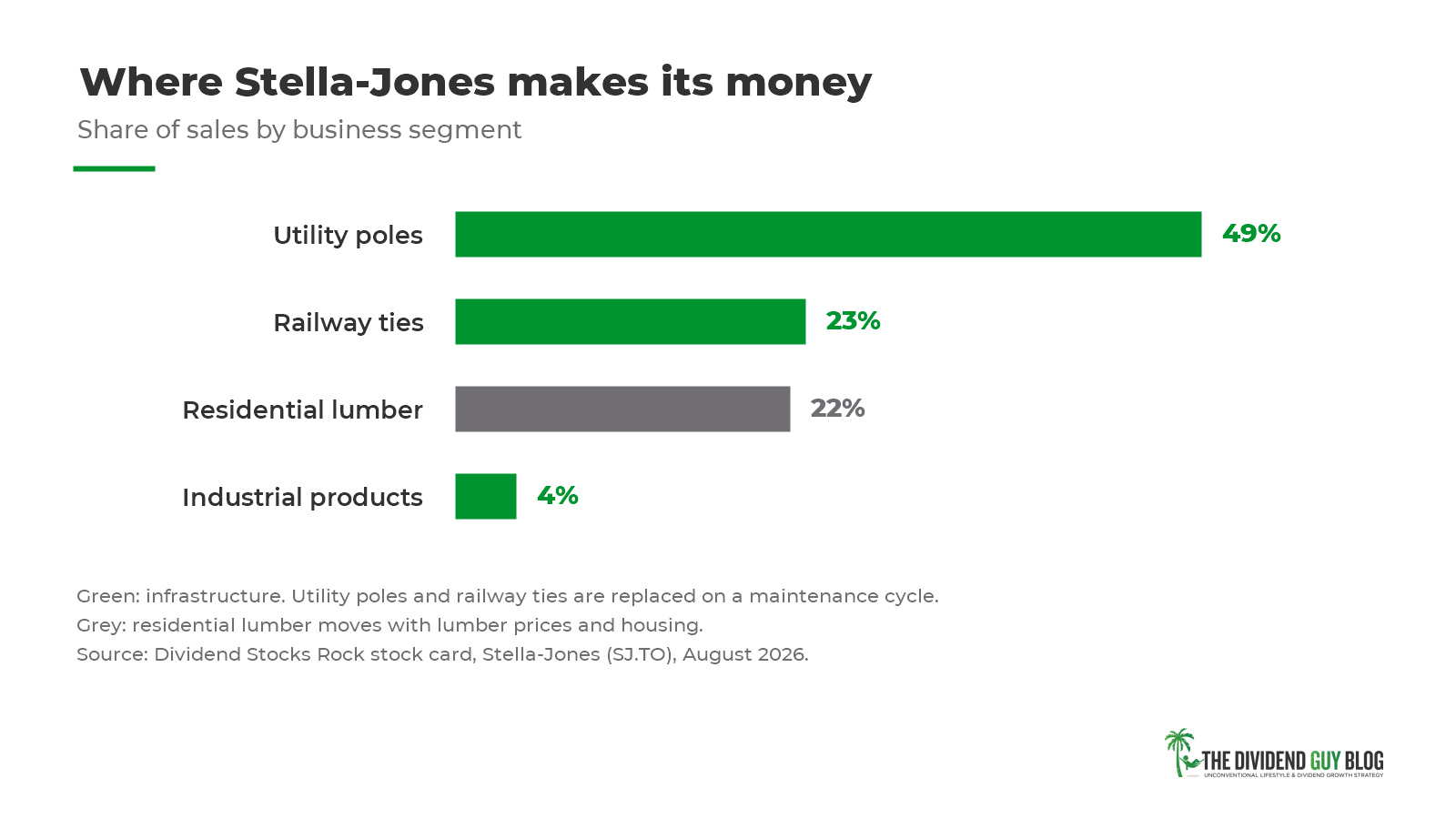
Residential lumber is the volatile piece. It moves with lumber prices and the housing market, and it is more exposed to tariffs.
The rest works a lot like recurring revenue. Railroads have to maintain their ties. Utilities have to maintain their poles. And in a world that needs more power, grid investment means more pole orders.
The company has also built its moat over decades. It runs treating plants across Canada and the US, close to its customers, and it has long-standing relationships with the utilities and railroads it supplies.
What Happened to the Margin?
Costs rose faster than prices. Fuel, environmental and maintenance costs went up, a plant upgrade slowed the steel structures business, and Stella-Jones could not pass all of it to its customers.
Second quarter sales went from $1.034 billion to $1.042 billion. No growth, but not a reason to lose a third of the stock price either.
The adjusted EBITDA margin is where it went wrong. It fell from 18.3% to 16%, a drop of 230 basis points, and earnings per share fell with it.
When sales are flat and earnings drop that hard, something inside the business changed. Here is what did.
Fuel costs went up. With the war in Iran not likely to end tomorrow morning, fuel will keep putting inflationary pressure on everything for the rest of the year.
Environmental management and maintenance costs increased at some sites.
The steel structures business ran into temporary inefficiencies while Stella-Jones upgraded its capacity. Upgrading a plant is the right move for the long term. In the short term, it hurts the margin.
Then Stella-Jones could not pass all those costs to its customers. It ate them, and the margin paid for it.
Why the Guidance Cut Hurt More Than the Quarter
The market liked the quarter even less once management spoke about the margin outlook.
Stella-Jones had set a target for 2026 to 2028: a margin between 17.5% and 18.5%. Management now says this year will come in below 17.5%.
Analysts built their assumptions on a margin above 17%. The quarter came in at 16%, and management confirmed it will stay under the original range. When guidance goes down, the stock price follows.
Management still expects the second half to improve as some of those costs ease.
One Segment Is Still Growing
The segments tell the same story.
Railway tie sales slipped from $240 million to $235 million. Volumes were lower and competition picked up.
Residential lumber had a rough quarter. Softer lumber prices, softer volume and poor weather all hurt.
Utility products were the bright spot. Volumes were up about 7%, and sales rose from $476 million to $510 million.
What Do the Five-Year Numbers Say?
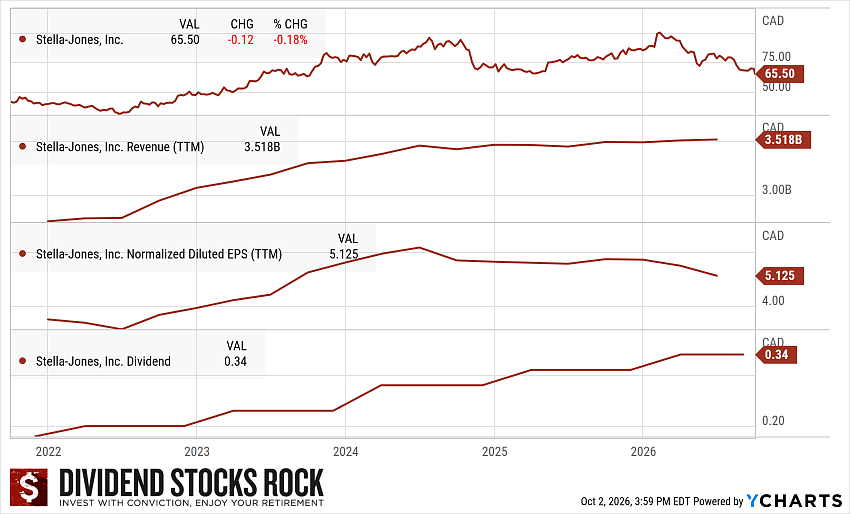
A slow and steady business with a fast-growing dividend. Over five years, revenue and earnings per share grew about 5% a year, and the dividend grew 13.5%.
Stella-Jones carries a PRO rating of 4 and a Dividend Safety score of 4. All three legs of the dividend triangle point up.
The dividend has almost doubled over the past five years, and Stella-Jones has raised it for more than 20 years in a row. The latest increase was 10%, to $0.34 per quarter.
A dividend growing more than twice as fast as earnings cannot keep that pace forever. It does not have to slow down in a hurry either. The payout ratio sits around 20% of earnings and 15% of cash flow.
Cash generation stayed strong through the bad quarter, at $192 million. Stella-Jones cut its net debt by more than $100 million in the first half.
On valuation, the forward PE is under 12 and the yield is close to 2%, against a five-year average of 1.4%.
Is This Kind of Volatility Normal for Stella-Jones?
Yes. The stock traded around $34 in 2022, near $95 in 2024, around $65 after Liberation Day, back near $100, and now sits around $70.
It goes up, it goes down, it goes up, it goes down.
Over the past few years, Stella-Jones has moved by high single digits, sometimes double digits, in a single day. That is part of owning it. I do not go crazy over the price. The margin is what concerns me.
I explained why I like this company when I picked my top Canadian dividend stocks for 2026.
Top 3 Canadian Dividend Stocks for 2026—And What 2025 Teaches Us
What Will I Watch in the Next Earnings Reports?
Three things: the margin and management’s path back to 17.5%, railway tie volumes, and utility pole sales.
1. The Margin
I want to hear management talk about the margin and how they get it back to 17.5%. That means running more efficiently, getting costs under control, and passing more of the inflation to customers.
This is the key piece. The moment Stella-Jones shows it can improve its profitability, I expect the market to notice.
2. Railway Tie Volumes
Railway ties are still an important segment. If volumes stay weak, it will be very hard for Stella-Jones to come back with strong numbers.
3. Utility Pole Sales
Utility poles are growing, and right now they hold up the rest of the business.
There is one risk here. Interest rates, inflation and a squeezed consumer could push a lot of companies to cut their spending budgets. Railroads and utilities could do the same, and hold off on new projects.
Stella-Jones would keep its baseline. There is a limit to how long you can delay maintenance, and nobody wants railway ties falling apart. The recurring orders will still come. Growth is going to be a tough ride.
I covered those rate and inflation pressures in more detail here.
The Verdict
The problem is the margin. Revenue growth is weak, and in a cyclical business like this one, that is normal.
The business model has not changed. Poles and ties still need replacing, and the grid still needs more poles. What changed is how much of each sale Stella-Jones keeps.
I still like the company. What you do with Stella-Jones is your call.
Learn to Read a Quarterly Report Yourself
Most of this article came from one quarterly report. Sales, margin, segments and guidance. Knowing which lines to read is what tells you a 30% drop is a margin problem and not a broken business.
Simplified Quarterly Earnings walks you through a report the way I read one. It is one of the three courses in Dividend Simplified, $15 for the set.







Leave a Reply