
On December 3rd, 2025, Telus froze its dividend growth. Seven months later, the stock sits near a decade low, and the yield has climbed above 11%. That number looks like a gift. It is closer to a warning.
If you still hold Telus (T.TO), you are probably nursing a hangover. Since the freeze, the stock is down about 11% including the dividend, while the broad Canadian market (XIU) is up 13.5%. That is a gap of more than 20 percentage points in seven months. So let me revisit the story, look under the hood, and answer the real question. Can Telus turn this around?
Disclosure: I sold my Telus shares on December 3rd, 2025. This is education, not advice. Do your own due diligence.
–> NEW!! Telus cut its quarterly dividend from $0.4184 to $0.1875 on July 31st. Management calls it a reset. A reset is what you do to your Wi-Fi router when there is a bug. When your income drops by 55%, it is a cut.
What Happened to Telus’s Dividend?
On December 3rd, 2025, Telus paused its dividend growth policy, walking back the 3% to 8% annual growth it had promised through 2028.
That is what stings. About six months earlier, management reassured the market that it would continue raising the dividend by 3% to 8% each year through 2028. Then it changed its mind and hit pause. Some improvisation. I hate that. When I invest in a dividend grower, the growth is the whole point.
To be fair, revising a plan is not always a bad thing. Couche-Tard did it with a clear roadmap and came out fine. But Couche-Tard was not struggling. Telus is. That is a big difference. A revised plan is only worth the paper it is printed on if the company can execute it.
Why Did I Sell My Telus Shares?
I sold Telus after the freeze because I invest for dividend growth. When growth stops, my capital moves to a business that will continue to reward me.
That is the rule, and the rule is the reason the system works. About a month ago, during a private DSR webinar, a member asked me to set my rules aside and look at Telus one more time. Is there any chance this nightmare of a story turns around? I agreed, because the point was to talk about Telus, not my portfolio.
Here is the lesson before we go further. Stick to your investment rules. You put them in place for a reason. If your rules tell you to buy, sell, or hold, follow them. One of my rules is simple. I focus on dividend growth. No growth, no position. I would rather invest my money in a company that rewards me than one that is improvising with its dividend policy.
What Is Telus’s Turnaround Plan?
Telus wants to grow free cash flow, cut capital spending, pay down debt, sell assets, end its discounted DRIP by 2027, and pause dividend growth to fund these initiatives.
I liked most of this plan, right up until they took dividend growth off the table. The logic runs in six parts.
- Grow free cash flow, led by Telus Health, Telus Digital, and the core telecom business.
- Cut capex now that the heavy 5G and fibre buildout is behind them.
- Use the extra cash flow to pay down the debt that ballooned over the past decade.
- Monetize assets to accelerate debt payoff.
- End the discounted DRIP by 2027 so the company stops issuing new shares.
- Pause dividend growth to free up cash flow flexibility.
The debt story matters most. Cheap debt was a gift when rates were near zero. It became a weight when rates rose. Paying it down is personal finance 101. Stop the extra spending, kill the interest charges, and free up cash for the future.
One part I respected. Telus sold 49% of its cell tower network to a pension plan and used the proceeds to pay off debt. Compare that to BCE, which sold its MLSE stake, said it would pay off debt, then bought Ziply Fiber instead. Telus said it would deleverage, and so far it has. Execution counts.
There is one catch worth naming. The DRIP is propping up the payout. Each quarter, more shareholders take stock instead of cash, so Telus pays out more dividend dollars on paper while sending less cash out the door. That is dividend growth on paper only. Real people are not getting more money unless they are enrolled in the DRIP.
Is Telus Executing the Plan?
The execution is uneven. Free cash flow jumped 19% last quarter, but capex rose 11% and cash from operations slipped 3%. Not a clean beat.
In the latest quarter, revenue came in at around $5 billion, down 1%. Weak revenue growth again. Adjusted earnings per share fell 12%, though for a capital-intensive business like this, cash flow tells you more than EPS. The 19% jump in free cash flow is the good news. It shows debt payoff starting to free up cash that used to go to interest.
The bad news is that cash from operations fell 3% and capex climbed 11%. That is not perfect execution, and the market has noticed. The 2026 guidance stayed intact after one quarter. Revenue growth of 2%-4%, capex of around 2.3 billion, and free cash flow of near 2.45 billion. Management is also leaning on an AI revenue story, targeting roughly 2 billion by 2028 from about 1 billion today. When you are struggling somewhere, you can always play the AI card. Telus reports again at the end of July, so we will get a fresh read soon.
Will Telus Cut Its Dividend?
–> NEW!! Telus cut its quarterly dividend from $0.4184 to $0.1875 on July 31st. Management calls it a reset. A reset is what you do to your Wi-Fi router when there is a bug. When your income drops by 55%, it is a cut.
Free Special Report: dividendstocksrock.com/telus
The market is pricing in a cut. An 11% yield is not a reward. It is investors telling you they doubt Telus can fund this payout from cash.
Here is where the DSR framework earns its keep. Our first filter is the dividend triangle.
Revenue growth, earnings growth, and dividend growth over five years, all pointing up together. Telus fails that filter. Over the past five years, revenue grew about 4.7%, but earnings per share shrank 8.6%. The dividend still climbed by nearly 6% a year, even as earnings fell. You cannot grow a payout on a shrinking bottom line forever.
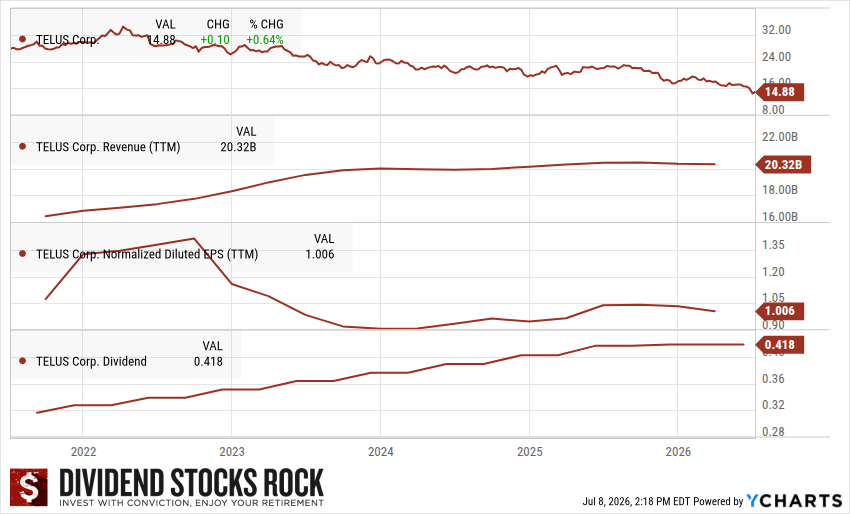
The payout math confirms the strain. On a classic cash basis, the payout ratio sits above 100%. It only drops into the mid-70s once you fold in the DRIP, the financial engineering we just discussed. Telus has raised its dividend for 22 straight years, one of the longest streaks in Canada, and that streak is now living on borrowed time. A high yield alone is not a reason to run. Enbridge hit 8% recently and recovered nicely. But a high yield sitting on a broken dividend triangle is a different animal.
Is Telus Stock Cheap Right Now?
On paper, yes. Telus trades at a forward PE near 15, compared with a five-year average of around 30. But a low multiple on falling earnings is not a bargain.
The current PE sits around 25, the forward PE drops near 15, and the five-year average is close to 30. On yield, the forward 11% is well above the five-year average of about 7.3%. That gap indicates the price has fallen sharply relative to its own history. Read it as an entry-point signal, not an income pitch. A lower price only matters if the underlying thesis holds, and right now the thesis is a question mark.
Before you buy any low-multiple, run the business through a full process rather than buying the yield. Here is how I find and analyze stocks to buy before I put money to work. A cheap price on a broken thesis is a trap. A cheap price on a sound thesis is an opportunity. Telus has not yet proven which one it is.
My Take on Telus Right Now
Can Telus turn around? Right now we are in hope territory, not on solid ground. I am not saying it will not happen. I am saying that at an 11% yield, the market is bracing for a cut. The plan is still on paper. Some of the execution makes sense, some of it does not.
Seven months after the freeze, I am glad I sold. I followed my rules, moved on, and put my capital into names with clearer growth. That is the part I control. You do you. Decide what fits your portfolio and your conviction.
The Hard Part Is Knowing When to Let Go
Selling Telus took one rule and one honest look at the dividend triangle. Knowing when to sell is the part that trips up most investors. A stock yields 11%. Is that a bargain or a trap? The dividend growth stops. Do you hold and hope, or move on?
That is what I teach in Dividend Simplified. It is a short, practical course that walks through my buy process, my sell process, and how to read a quarterly earnings report without a finance degree. Bite-sized videos, PDF guides, and the same checklists I use. The whole thing costs $15.
If you have ever held a stock like Telus and frozen, this course was built for you.







Great write-up. I think your point about sticking to predefined investment rules is the biggest takeaway. It’s easy to get tempted by an 11% yield, but a frozen dividend and weakening fundamentals are a reminder that yield alone isn’t an investment thesis. Thanks for sharing your analysis.
Hi Mike: Telus is definitely a zombie stock that will likely take years to revive.
Interesting past few years by Microsoft and ExxonMobil.
We are off to the UK, Ireland and Iceland next month via the Queen Mary 2. Leisurely passage for less than Business or Premium Economy airfares.
All the best to you and your family.
Great analysis! An 11% yield is certainly tempting, but the frozen dividend growth, high payout ratio, and debt concerns are hard to ignore. A good reminder that a high yield can sometimes be a warning sign rather than an opportunity. Thanks for the detailed breakdown!