
Scotiabank grew earnings per share 21% last quarter. BMO grew 22%.
Both used the word record. Neither was exaggerating.
This is the best week of the summer if you own Canadian banks, and it started about as well as it could have. I went through both quarters line by line looking for a problem. In the operations, I could not find one.
I found something else instead. It is not in the results. It is in the price.
Here is the short version. The growth is real. Most of it came from two segments that only perform like this in a bull market. And both stocks now trade about 39% above the price-to-earnings ratio they have averaged over the past five years.
*Disclosure: I own National Bank (NA.TO) and Royal Bank (RY.TO). I do not own Scotiabank (BNS.TO) or Bank of Montreal (BMO.TO). This is education, not advice. Do your own due diligence.*
Here is the full breakdown on video if you would rather watch it than read it.
How Did Scotiabank and BMO Do in Q3 2026?
Both posted record quarters. Scotiabank grew earnings per share 21% on revenue up 11%. BMO grew adjusted earnings per share 22% on revenue up 10%.
Start with Scotiabank, and keep in mind it is not my favourite name in the group.
Revenue rose 11%. Earnings per share rose 21%. The CEO called it a record quarter, and the segment numbers back him up.
Canadian banking net earnings were up 12% on stronger revenue and a better interest margin. That is the core business doing what it is supposed to do. Higher provisions for credit losses, mostly in the corporate and commercial portfolio, held it back a little, and I will come back to that.
International banking rose 8% on better margins, better revenue, and lower provisions.
That number deserves a sentence of its own. The whole Scotiabank thesis is that international exposure lets it outperform a bank built only for Canada. This quarter, international grew 8% while Canadian banking grew 12%. Positive, and high single digit is nothing to complain about. It is still not the outperformance the strategy promises.
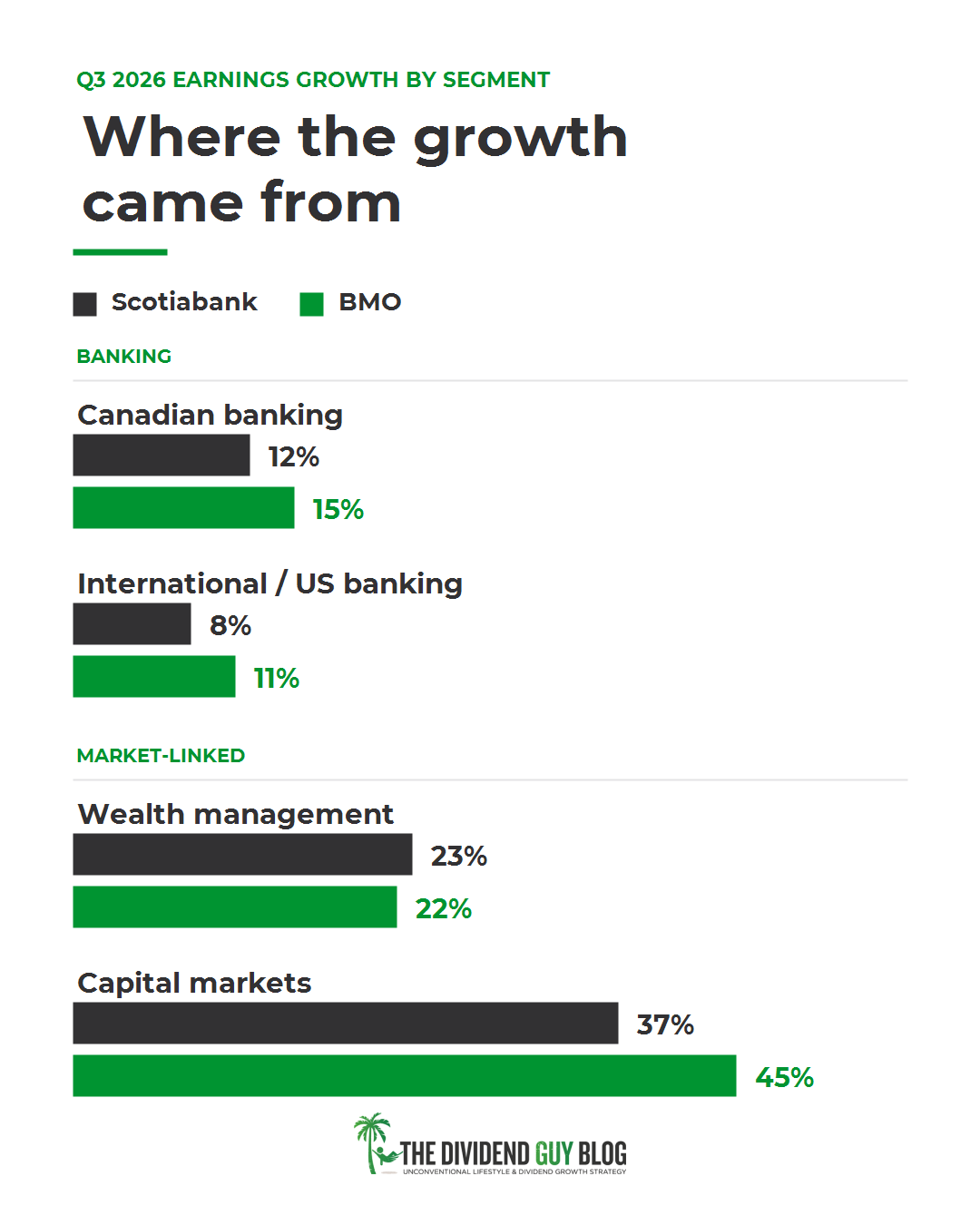
Then the two that carried the quarter. Wealth management up 23%. Capital markets up 37%.
BMO told a similar story with different numbers.
Revenue up 10%. Adjusted earnings per share up 22%. I use the adjusted figure because it gives the cleaner picture of the operating business.
Canadian personal and commercial banking rose 15%, built on a 6% revenue increase and lower provisions for credit losses. More loans issued, more interest earned, and less money set aside for bad debt.
US banking rose 11%, again on higher net interest income, a higher net interest margin, and lower provisions.
Wealth management rose 22%. That came in despite insurance falling 8% against last year, and that decline is not a business slowing down. It reflects assets BMO sold in earlier quarters.
And capital markets rose 45%.
Read that last one again. Global markets, investment banking, corporate banking, all firing at once. Am I describing an AI chip company or a boring, stable Canadian bank?
Where Did the Growth Actually Come From?
Capital markets and wealth management. Scotiabank grew capital markets 37% and wealth 23%. BMO grew capital markets 45% and wealth 22%.
Line the segments up and the pattern is impossible to miss.
The banking businesses, the parts that take deposits and make loans, grew between 8% and 15%. Good numbers. Normal numbers.
The market-linked businesses grew between 22% and 45%.
That gap is the entire quarter.
Here is why it works this way. Wealth management earns a percentage of assets under administration. When markets rise, that asset base rises with them, and so does the fee. The bank does not have to win a single new client to make more money. Its existing clients got richer, so the bank did too.
I worked in a bank for more than ten years, and I can tell you what that looks like on the ground. Trying to move a client’s account in a rising market is close to impossible. You call, you are professional, they like you fine. Then they tell you they just got their statement, they are up 12% this year, and why would they change something that is not broken? Totally fair question.
So the business is sticky on the way up.
Capital markets is the same story, with more leverage. Market making, order flow, new issues, institutional demand. When everyone is bullish, there is demand for all of it, and the bank takes a cut of every piece.
Both of those work in reverse.
What Are Provisions for Credit Losses Telling You?
They split this quarter. Scotiabank raised provisions 3.7% to $1.079 billion. BMO cut provisions 9% to $722 million.
Provisions for credit losses are the money a bank sets aside for loans it expects will not be repaid. It is a judgment the bank makes about its own loan book. Set aside less and reported earnings go up. Set aside more, and they go down.
That makes it the biggest swing factor in a bank quarter, and the line most investors skip.
Scotiabank raised its provisions 3.7%, to $1.079 billion. A small increase, concentrated in the corporate and commercial portfolio.
BMO went the other way and cut its provisions 9%, to $722 million.
Put those side by side and it changes how you read the headline growth. BMO’s Canadian personal and commercial segment grew 15% on a 6% revenue increase. Some of that gap is the operating business. Some of it is the provisions line moving in BMO’s favour.
Neither bank did anything improper. Releasing provisions when your credit book is performing is exactly what a bank should do. But a quarter built on falling provisions is a different quarter from one built on growing revenue, and the difference matters if you plan to hold the stock for a decade rather than a quarter.
The bigger signal is the one both readings share. Loans are getting paid. Despite tariff threats, commercial wars, and inflation, the economy is still resilient enough for these banks to make a lot of money.
Why Does the Canadian Bank Valuation Look Stretched?
Both trade roughly 39% above their own five-year average. BMO sits near 18 times earnings against an average of 13. Scotiabank near 16.7 against 12.
This is where the good news stops.
BMO trades near 18 times earnings. Its five-year average is about 13. That is a premium of 38.5%.
Scotiabank trades near 16.7 times earnings. Its five-year average is about 12. That is a premium of roughly 39%.
Scotiabank’s lower absolute multiple is not a bargain, by the way. It is earned. Scotiabank has lagged the other five on revenue and earnings growth over five, ten, and fifteen years, so the market has always paid less for it. That discount is justified. What is harder to justify is the same 39% premium sitting on top of it.
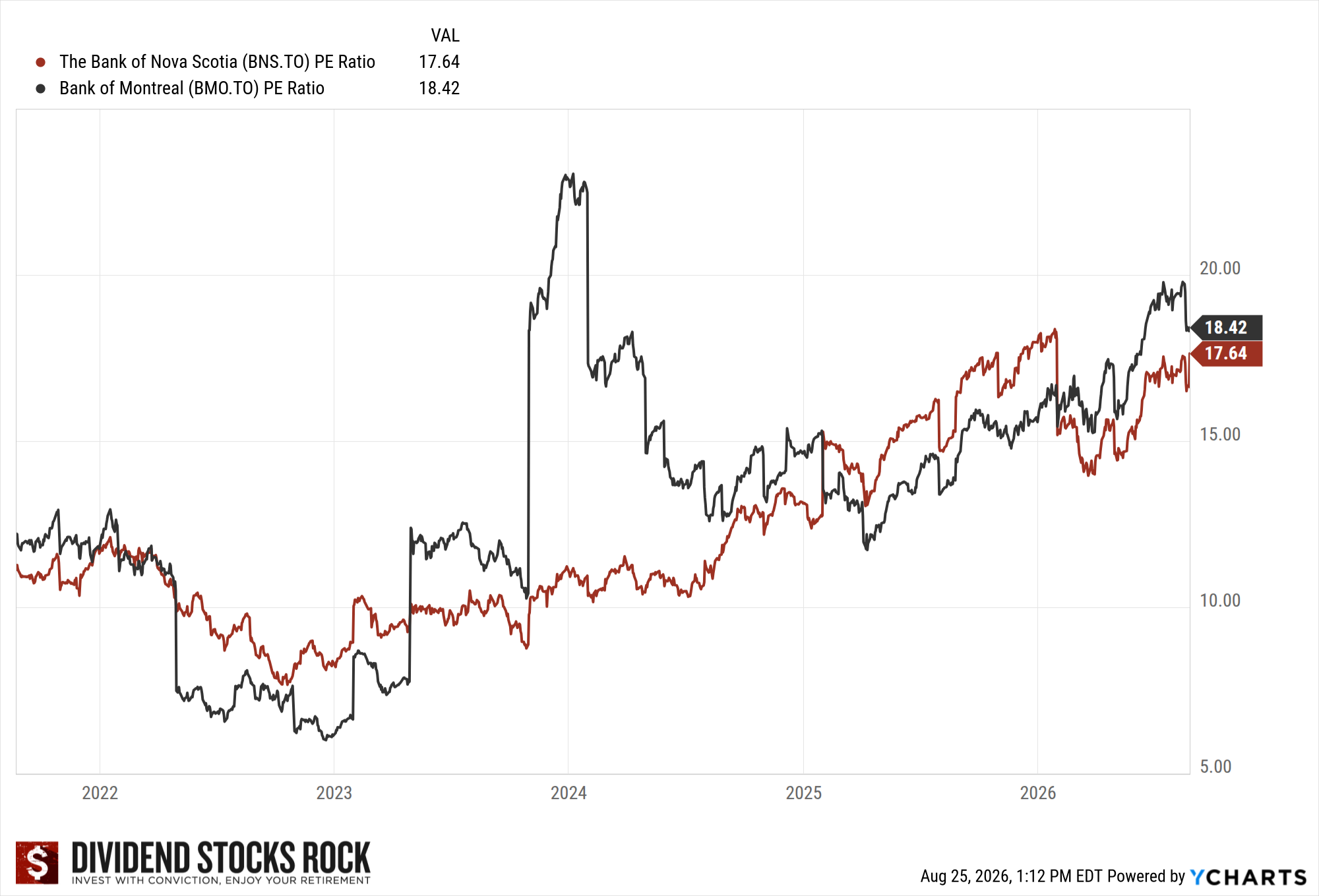
You are paying about 40% more than you have paid, on average, for the past five years. For both banks.
That is the number I keep coming back to.
What Happens When the Bull Market Ends?
The market-linked segments shrink with the market. A 10% to 15% drop in bank stocks at that point would be ordinary, not a crisis.
Wealth management and capital markets have posted double-digit growth quarter after quarter after quarter. That is the engine behind both of these results, and behind a good part of the premium.
It will not run at this speed forever. Markets are cyclical. At some point growth slows, or we get a bear market, because that is what markets do.
When it happens, those two segments shrink with it. Fee income on a smaller asset base. Less issuance. Less institutional demand. And the earnings that justify an 18 times multiple stop showing up.
So if your bank stocks drop 10% or 15% at that point, understand that nothing has broken. That would be normal.
Consider yourself warned, and then do nothing with the warning that you would not have done anyway. I am not telling you to sell. I am not changing a thing in my own portfolio. What I am saying is that knowing what you own, and how much of it you own, is worth more right now than it was two years ago, when the price left more room for a mistake.
What About the Rest of the Big 6?
National Bank reported Wednesday. Royal Bank and TD report this morning. All six Q3 releases land inside three days.
Scotiabank and BMO opened the week and set a high bar. National Bank followed on Wednesday. Royal Bank and TD close it out this morning.
If the first names set the tone, the rest should look similar. Strong operating results, a large contribution from the market-linked segments, and multiples that have moved a long way from their own history.
The thing to watch across all six is not the headline beat. It is the split between the banking segments and the market-linked ones, and which direction provisions moved.
I just did a live this morning to share a recap. Watch it here:
Get the Free Canadian Banks Report
All six banks reported within three days, and by the weekend most coverage will have moved on to something else.
So I built a complete report on the Big 6. It covers each business model, the latest quarter for all six, and a full section on valuation, because that is the part that is getting crazy.
It is free, and it goes out tomorrow morning, Friday, August 28th. Today is the last day to register if you want it in that first send.
You have to be on the newsletter to receive it.







Leave a Reply