
When a great company trades at an all-time high and a P/E north of 30, are you overpaying—or just paying for quality?
Mike and Vero show how to use the price-to-earnings (P/E) ratio without a crystal ball. Discover why a stock’s own 5- to 10-year averages matter more than cross-sector comparisons, how to identify “priced-for-perfection” setups, and why low P/E Ratios can be value traps.
Case studies: Visa (V), Costco (COST), Canadian Natural Resources (CNQ), National Bank (NA.TO)—plus what to do when prices skyrocket, how to think about all-time highs, and tweaks if you’re near or in retirement.
Save your spot (or get the replay) for our New Upcoming Webinar: thedividendguyblog.com/webinar
You’ll Learn
P/E that helps (not hurts) your decisions
-
P/E = price divided by earnings per share; it’s a multiple of today’s profits.
-
Use current and forward P/Es to separate momentum from expected earnings growth. Forward P/E relies on guidance/analyst estimates, so treat it as a scenario, not a fact.
-
Most important: compare a stock’s P/E to its own 5–10-year average and trend, not to a company in another industry with different economics.
P/E expansion: when the tag runs ahead of the tale
-
If price rises faster than EPS, the multiple “expands.” That can be rational (new runway, durable moat, better unit economics)… or just hype.
-
Multiples can’t expand forever. If growth underdelivers, stocks often “re-rate” back toward historical averages—fast.
Case study: Visa (V) — premium that’s ‘normal’
-
~34x current P/E; ~30x forward; ~36x 5-year average.
-
Translation: not a bargain, but not an overpay versus its history. A durable, asset-light network with secular growth can justify a steady premium—if revenue/EPS keep compounding.
-
What to watch: cross-border volumes, new flows (B2B, real-time payments), and regulatory pressure on fees.
Case study: Costco (COST) — priced for perfection
-
~53x current P/E; ~52x forward; ~44x 5-year average –> roughly an 18% premium to its norm.
-
Why investors pay up: subscription-like membership income, scale advantages, relentless traffic growth, global store runway.
-
Risk: even a solid quarter can disappoint if expectations are sky-high; a simple re-rating back to the 5-year average implies a ~15–20% drop without any business deterioration.
Low P/E doesn not cheap: two contrasts
-
CNQ (~11x P/E; recent range ~12–15x): looks “cheap” next to Visa/Costco, but energy is cyclical. Compare to its own range and peers, and weigh oil price sensitivity, capex discipline, and FCF allocation.
-
National Bank (NA.TO) (~14x; banks’ long-term norm: ~10–11x): a lower absolute multiple than tech, yet a premium compared to its own group. Not necessarily a deal unless growth/returns justify the higher bank-sector multiple.
-
Classic value-trap tell: falling revenue/EPS with a single-digit P/E (think Macy’s in retail). If the Dividend Triangle (revenue, EPS, dividend growth) is deteriorating, the low multiple often signals risk, not opportunity.
All-time highs are just timestamps
-
“ATH” triggers anchoring (“it must come back down”). Mike’s lesson: the best time to invest is when you have money and a solid thesis.
-
2017 felt “expensive” in real time; with hindsight, it was attractive. Focus on business quality and trends, not just price.
Skyrocketing names & ‘perfection’ setups
-
When a stock’s multiple stretches far above its own history and expectations are heroic, assume tight margins for error.
-
Playbook: do a deeper business-model check, size positions conservatively (smaller for small caps/higher-volatility stories), and be willing to trim if a holding swells beyond your risk limits (e.g., >8–10% of portfolio).
Near or in retirement? Tweak, don’t flip the table
-
You still have decades of market cycles ahead. Keep quality compounding engines, but pair them with:
-
A cash reserve for 1–2 years of withdrawals, so you’re not forced to sell on dips.
-
Periodic rebalancing (trim oversized winners, shore up lagging allocations).
-
Fewer high-beta, high-multiple bets as core holdings; let speculative ideas live in a small sandbox.
-
A simple buy/sell framework to avoid paralysis
-
Write/refresh your investment thesis (how the company grows revenue, expands margins, and reinvests).
-
Check the Dividend Triangle trend. If revenue/EPS/dividends aren’t compounding, be skeptical.
-
Compare current & forward P/E vs. 5–10-year averages and peers; ask why a premium/discount exists.
-
Decide position size and rules (e.g., trim above 8–10%, give turnarounds 2–3 years unless the thesis breaks).
-
Execute (lump sum or DCA), then review quarterly with this same checklist—no crystal ball required.
Free Webinar: Avoid Price Confusion and Act with Conviction
When a stock dives or spikes, most investors react to the price. In this session, we’ll show you how to ignore the noise and interrogate the business—so you can decide, confidently, whether to sell, hold, or buy more.
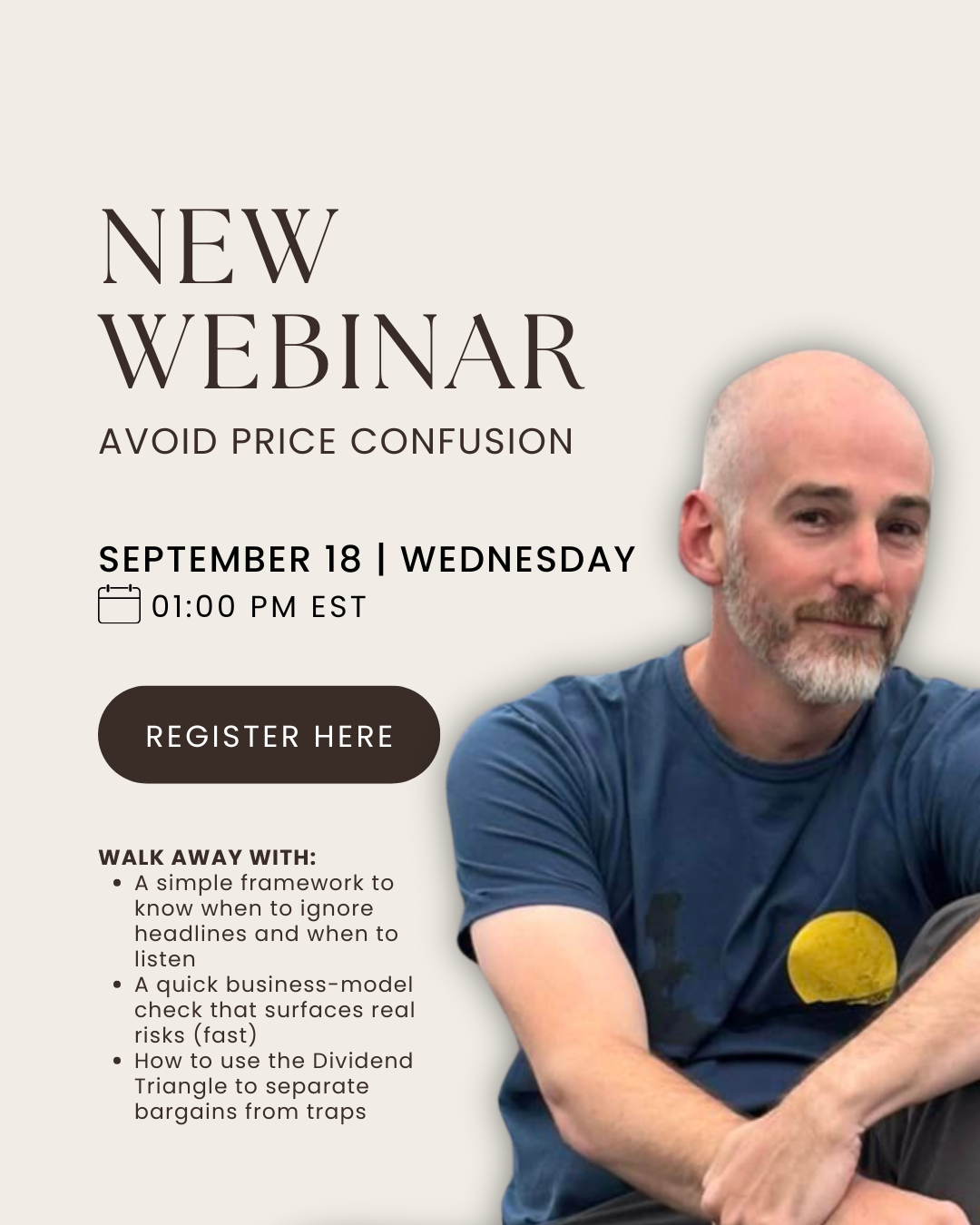
You’ll learn:
-
A simple framework to know when to ignore headlines and when to listen
-
A quick business-model check that surfaces real risks (fast)
-
How to use the Dividend Triangle to separate bargains from traps
Details:
-
Thursday, September 18th at 1:00 p.m. ET
-
100% free (no strings attached); replay for all registrants
-
~50-minute presentation + 1-hour live Q&A
-
Handouts/resources for live attendees
-
Live seats limited to the first 500
If you’re tired of not knowing why a stock moves ±10% on earnings day, this is for you.
Save your spot (or get the replay): thedividendguyblog.com/webinar
Related Content
Eight years after rolling a $108K pension into a DIY portfolio, Mike walks through a quarterly review that’s up ~200% since inception—but not without bruises. He dissects three laggards, explains when he holds vs. trims, and shows the exact process he uses to separate price noise from business news.
Mike’s Portfolio Review – Losing Money on Apple, Keep or Sell? [Podcast]
Is a recession just around the corner—or are we already in one without realizing it? Mike and Vero tackle the headlines, decode the signals, and most importantly, share what investors should actually do if they’re worried.
The Best Dividends to Your Inbox!
Download our Dividend Rock Star List now and do not miss out on the good stuff! Receive our Portfolio Workbook and weekly emails, including our latest podcast episode!
Follow Mike, The Dividend Guy, on:
Have Ideas?
If you have ideas for guests, topics for The Dividend Guy Blog podcast, or simply to say hello, then shoot me an email.
This podcast episode has been provided by Dividend Stocks Rock.








Leave a Reply